
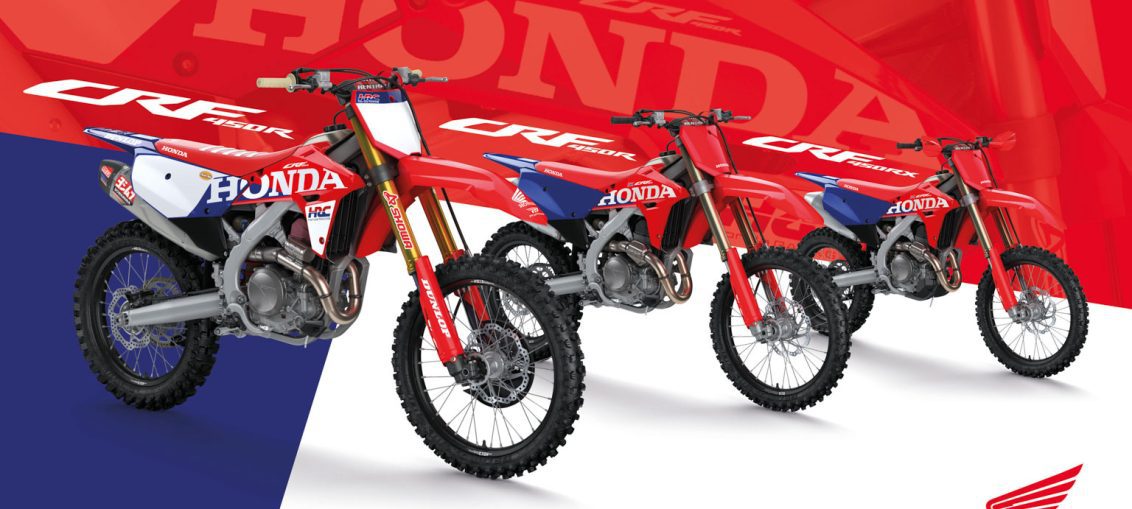
Kings of the rough stuff: New CRF450 models headline CRF family changes
- New CRF450 HRC-WE joins significantly upgraded CRF450R, CRF450RX to spearhead CRF family updates
- All CRF’s developed under the concept of Kiwami (‘Ultimate’) – in pursuit of the ultimate in light weight and high performance
- New frame and major engine updates transform 450s
- CRF450 HRC-WE brings stand-out appearance and performance thanks to titanium header pipe, bespoke exhaust silencer alongside unique graphics and seat cover
- CRF250R and CRF250RX receive visual overhaul to keep unified CRF family look
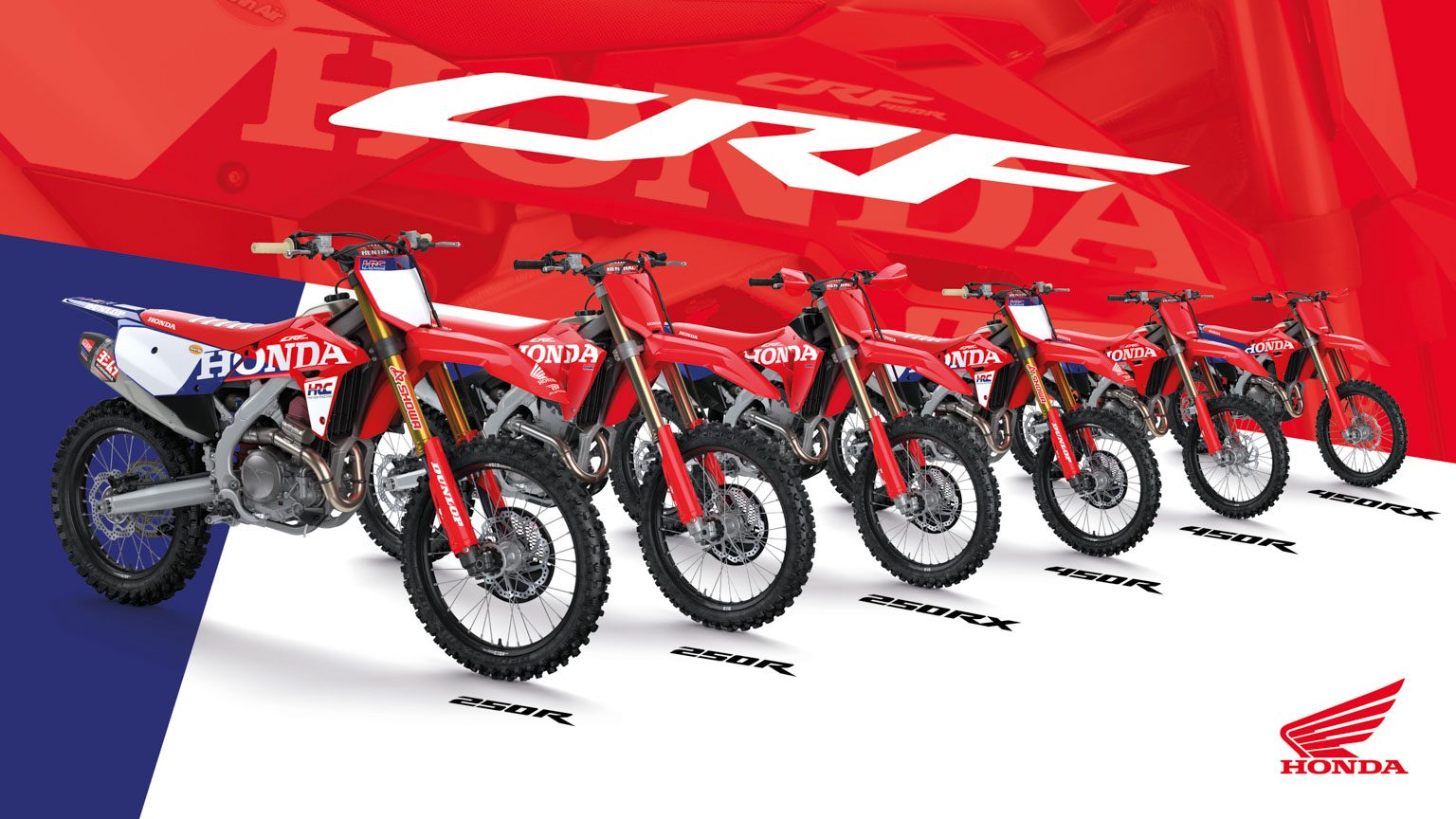
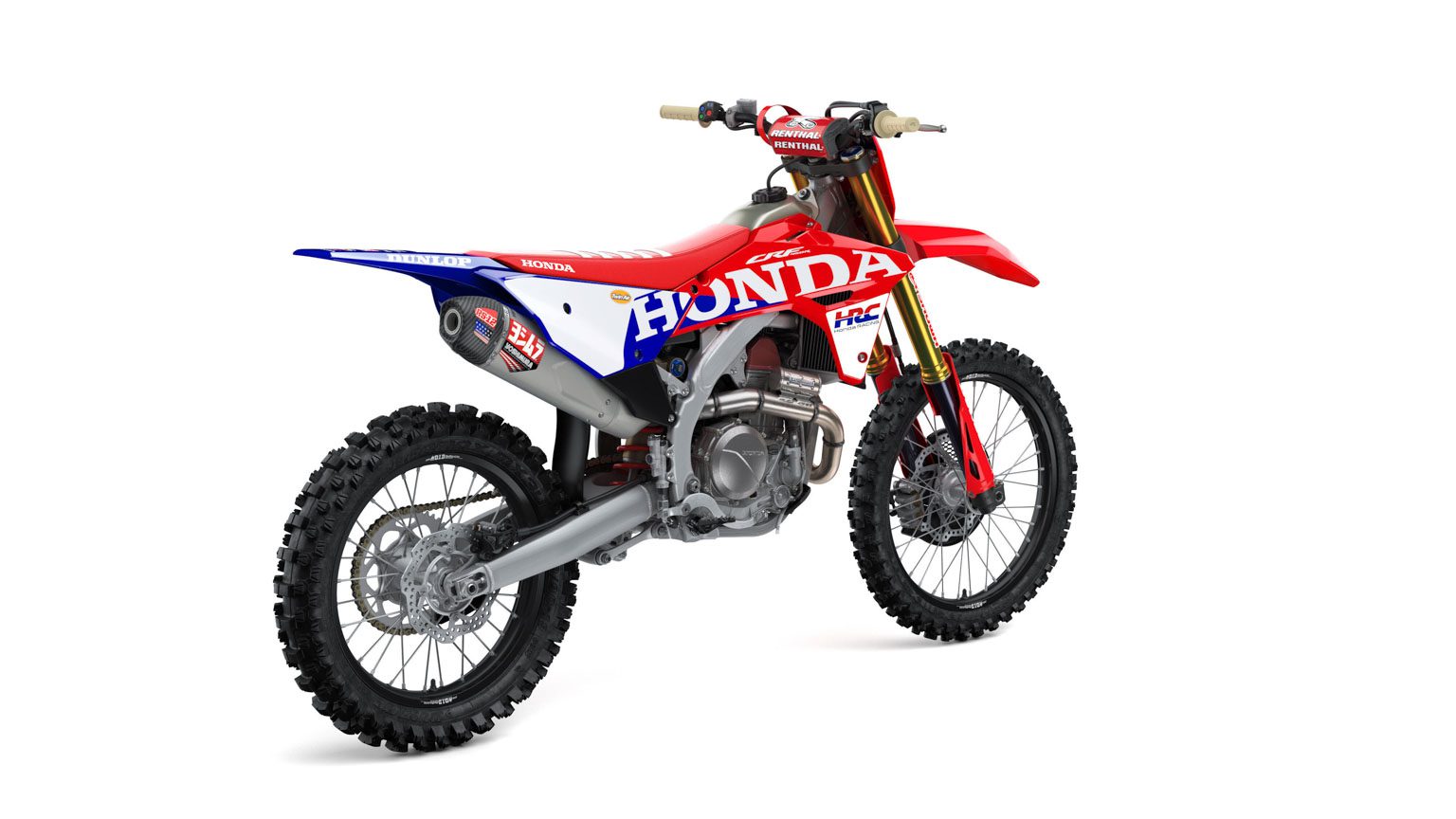
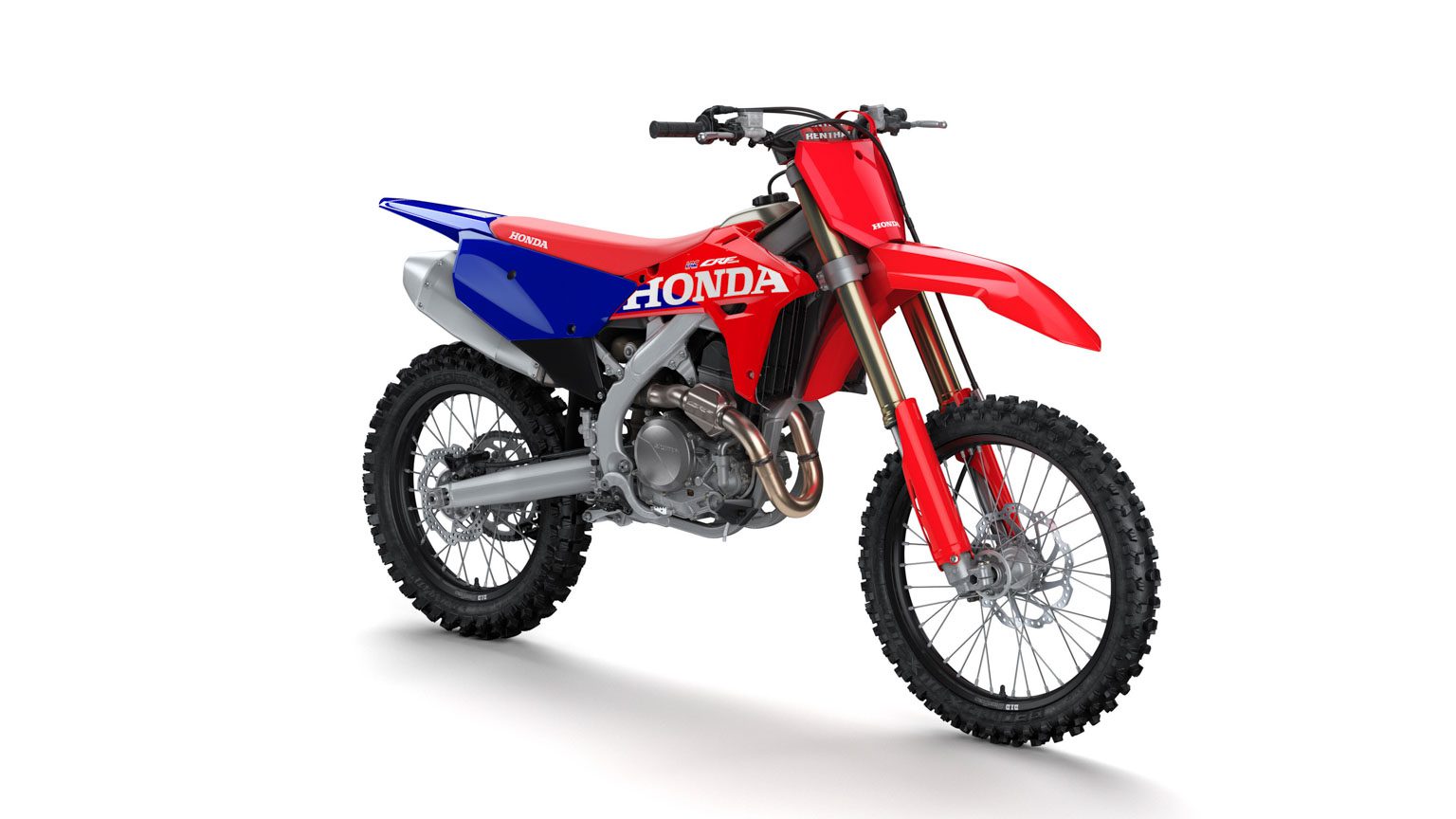
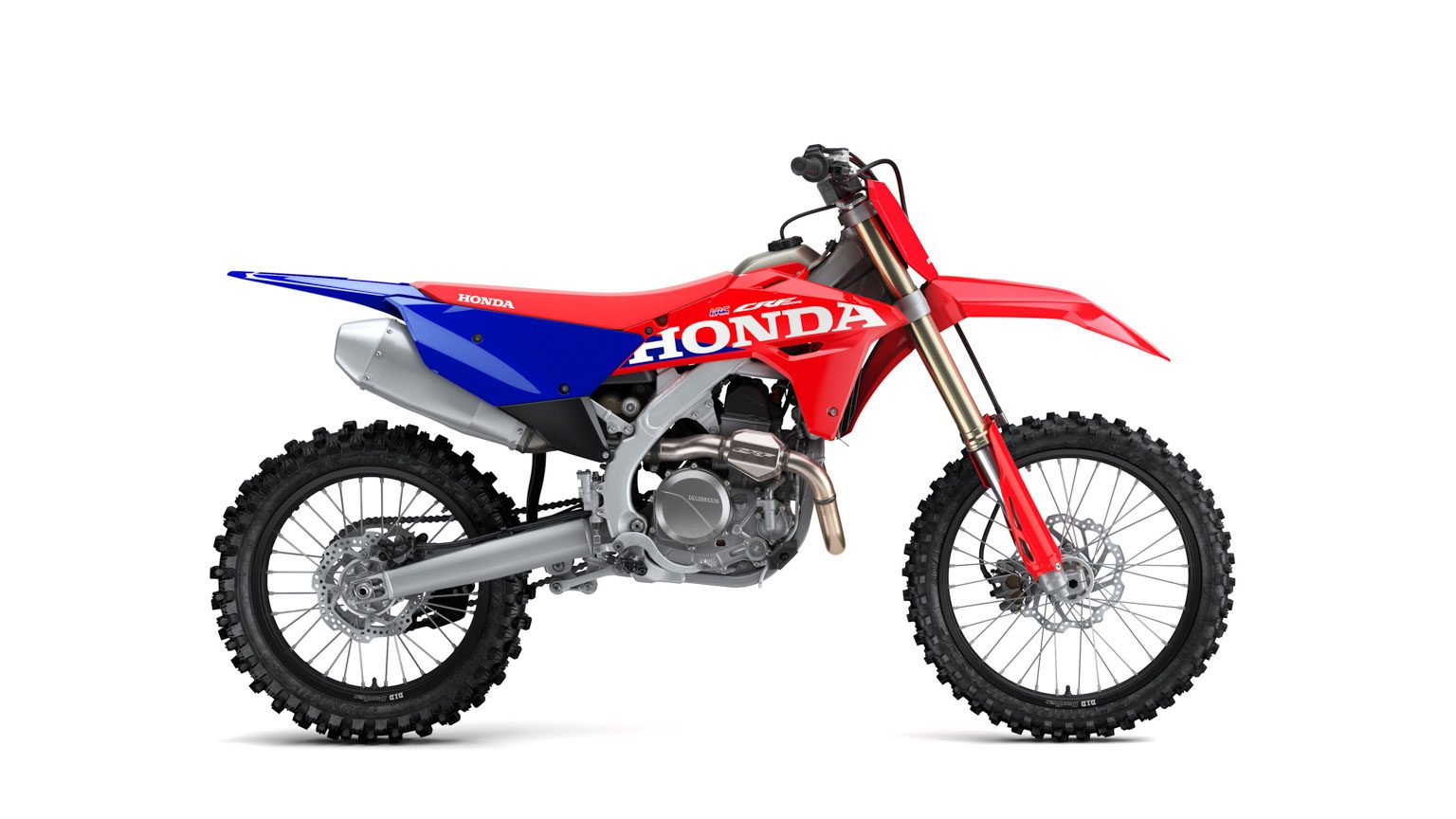
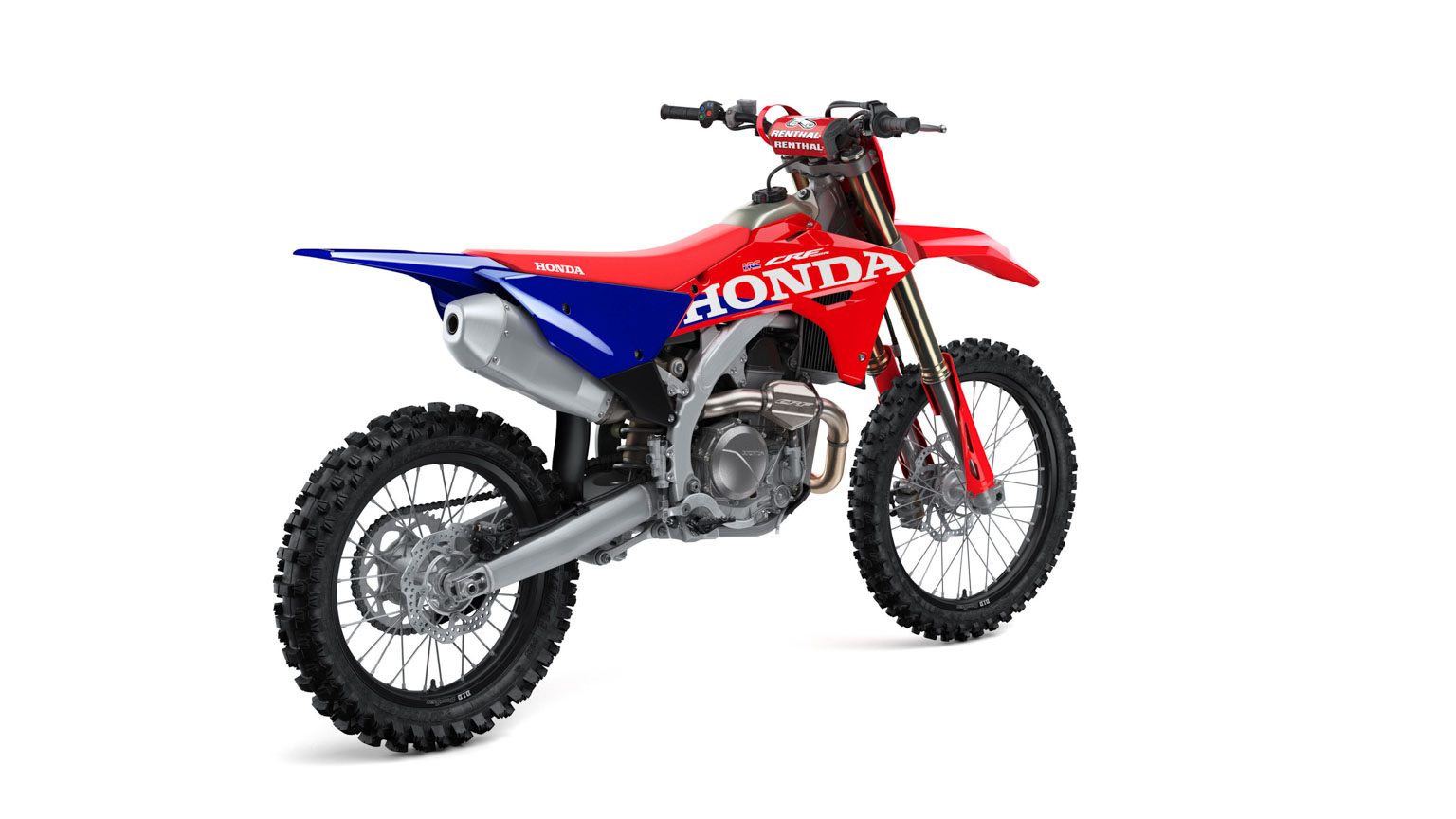
Honda’s enduringly popular CRF range of off-road machines have undergone a major overhaul for 27YM. There is also a new name in the line-up, as the CRF450R and CRF450RX are joined by the new headliner, the CRF450 HRC-WE; the CRF250R and CRF250RX receive minor visual changes to keep them in line with their bigger siblings.
The 27YM CRF450R is effectively a brand-new machine that follows a simple recipe for success: more power, less weight. Building on the strengths of the previous model the CRF450R sports a brand new, much more powerful engine housed in a redesigned, lighter chassis with a completely revised suspension philosophy.
The headline figures standout: 10% more power, and 4% more torque. The result is a machine that accelerates harder, responds faster, and is noticeably lighter and more agile on track.
The performance gain starts with a more efficient, harder-revving engine. The redesigned, more compact unit features a larger bore, a new piston with revised crown, and an all-new crankshaft that enables a shorter stroke and higher compression ratio. Larger titanium intake valves join newly introduced titanium exhaust valves, while a reworked UNICAM valve train improves gas flow efficiency, helping the engine breathe better and deliver stronger, more usable power.
Drive out of corners is improved through a more compact transmission with revised gear ratios, increasing rear wheel thrust across a wider speed range to allow riders to apply power earlier and with greater confidence. The clutch introduces a world-first rubber damper-activated Back Torque Limiter (BTL), bringing refined slipper performance validated by HRC in MXGP, while a redesigned starter motor saves both weight and space.
Control is just as important as outright performance, and the electronics package reflects that. HRC Launch Control and Honda Selectable Torque Control (HSTC) are now updated with settings taken directly from factory race machines, offering sharper, more adaptable performance in changing conditions. The Engine Mode Select Button (EMSB) continues to give riders instant control over engine character, tailoring delivery to suit both rider preference and track demands.
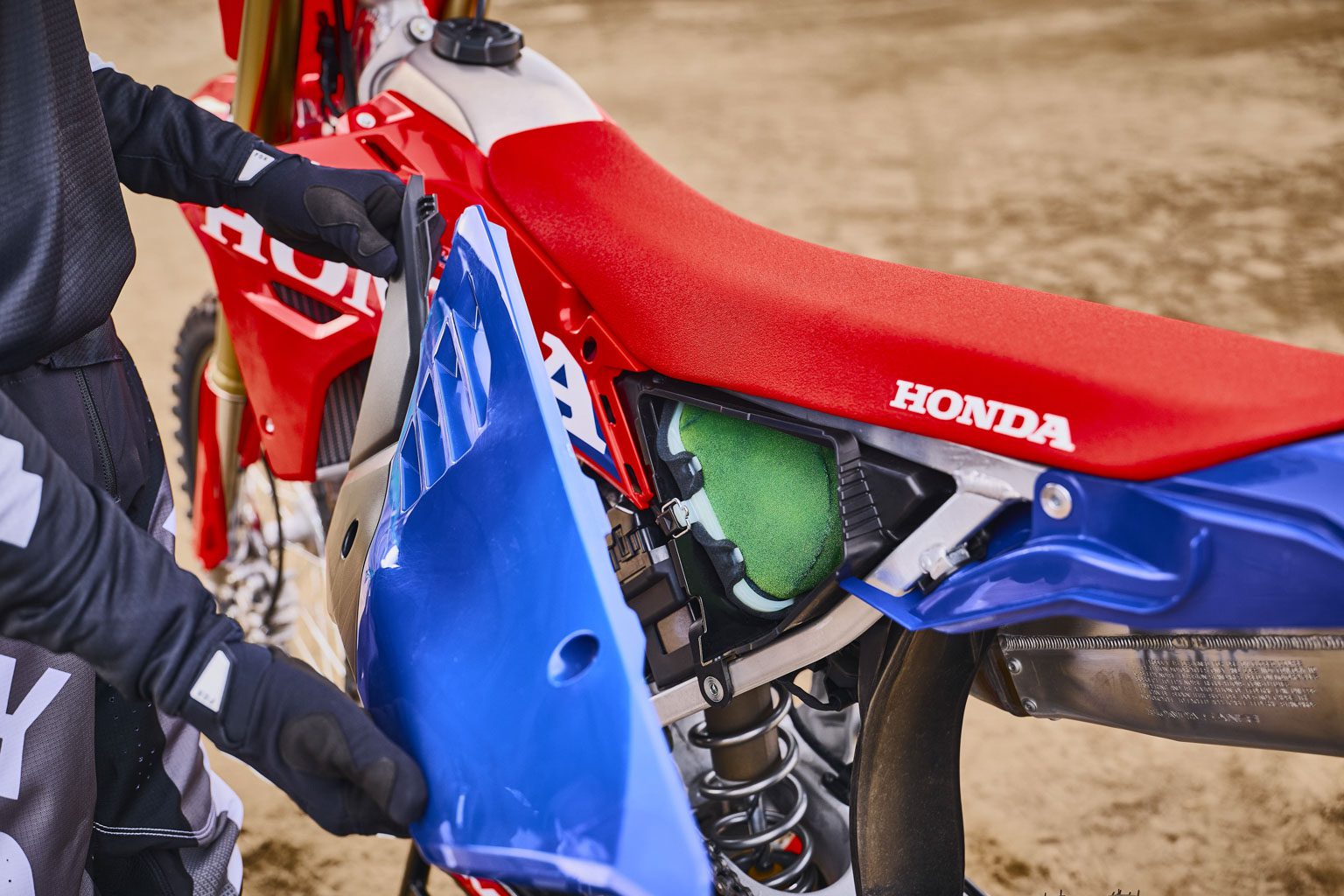
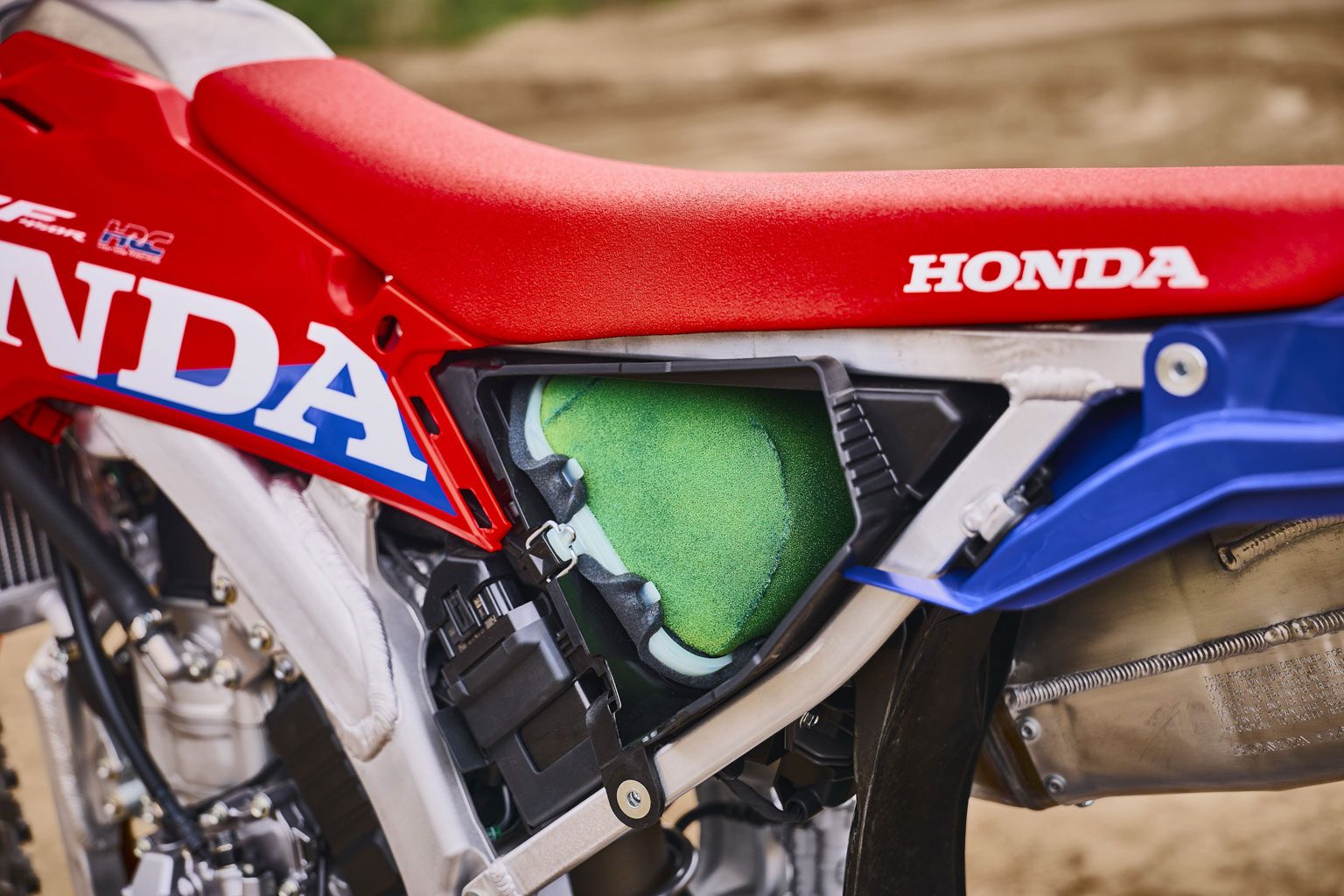
Handling has been sharpened, stability increased, and predictability across even the roughest of track conditions improved by a 70% new frame. New sections, optimized materials and manufacturing processes have increased overall rigidity without increasing weight over the 26YM. This new frame works in harmony with a new, lighter aluminium swingarm that has been shape-optimised not only for performance but also to improve access for air filter maintenance.
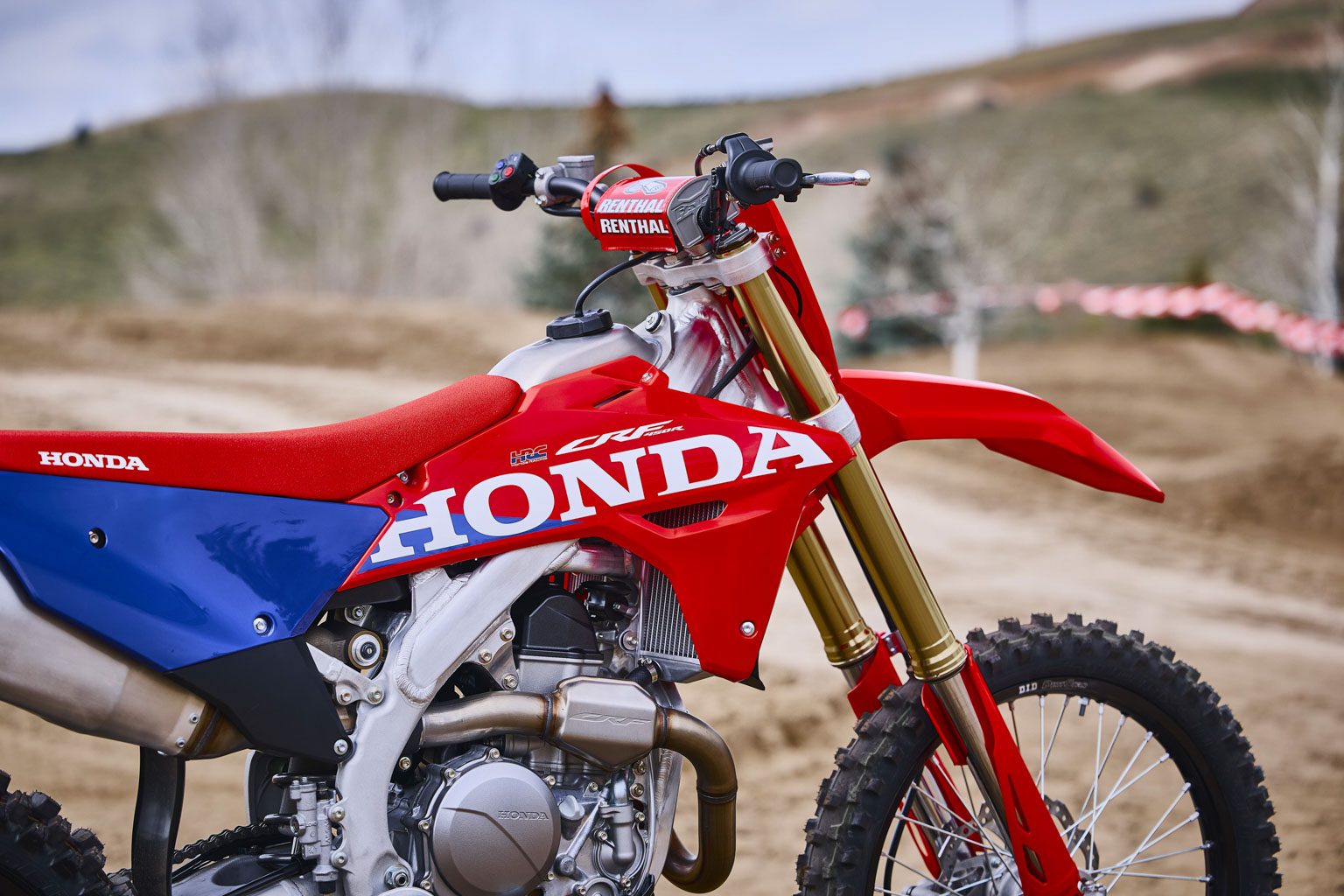
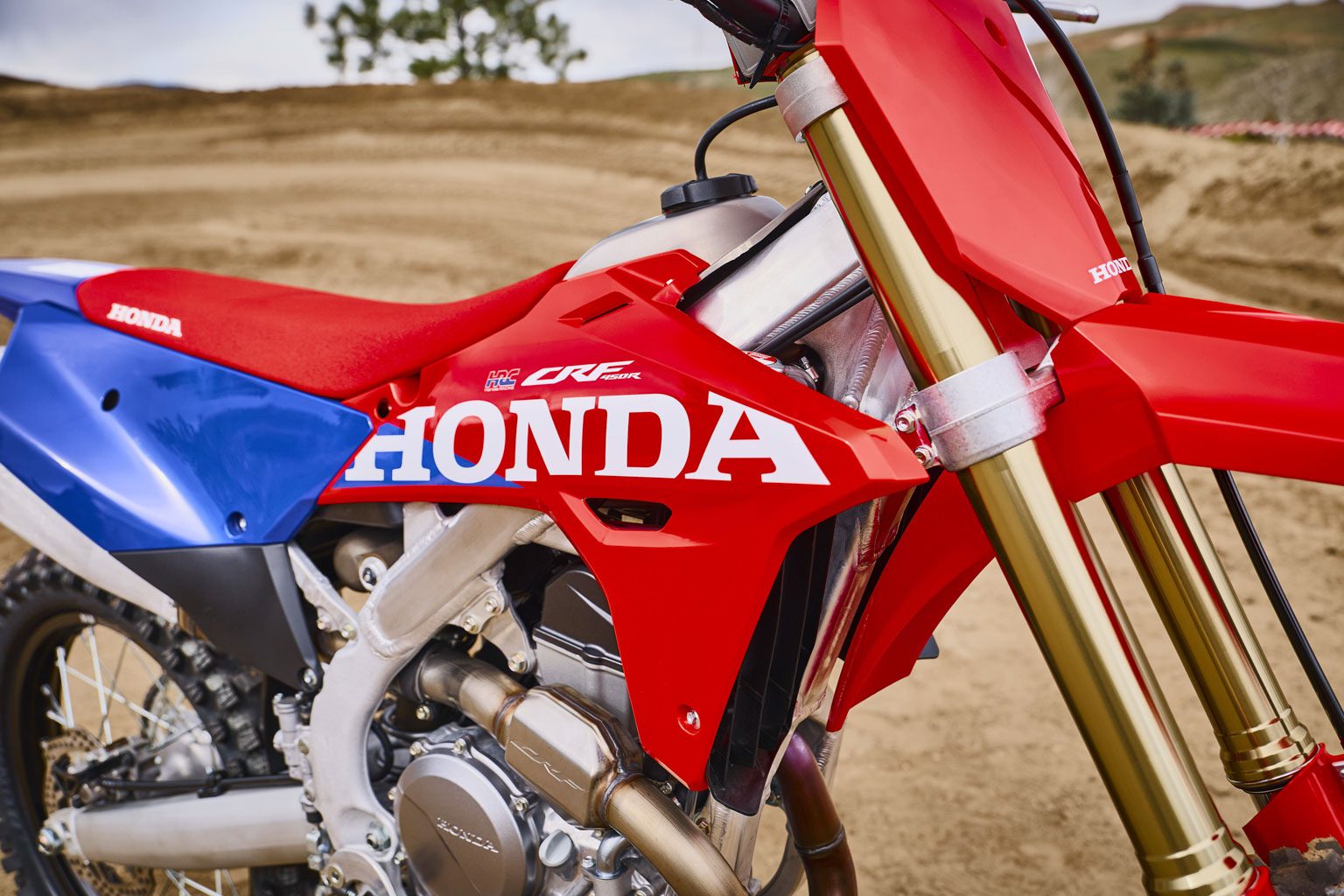
The 27YM CRF450R gains all-new dynamic bodywork with redesigned shrouds and side covers to allow a flat knee trajectory, front to back of the machine, to be maintained. The side covers are now symmetrical, and smaller in radius at the rear with deeper cutouts to improve rider gripping power when the rear is fully loaded under acceleration. For 27YM, the enduro-focused CRF450RX shares the redesigned bodywork – and for the first time ever – the slimline titanium fuel tank of its MX sibling.
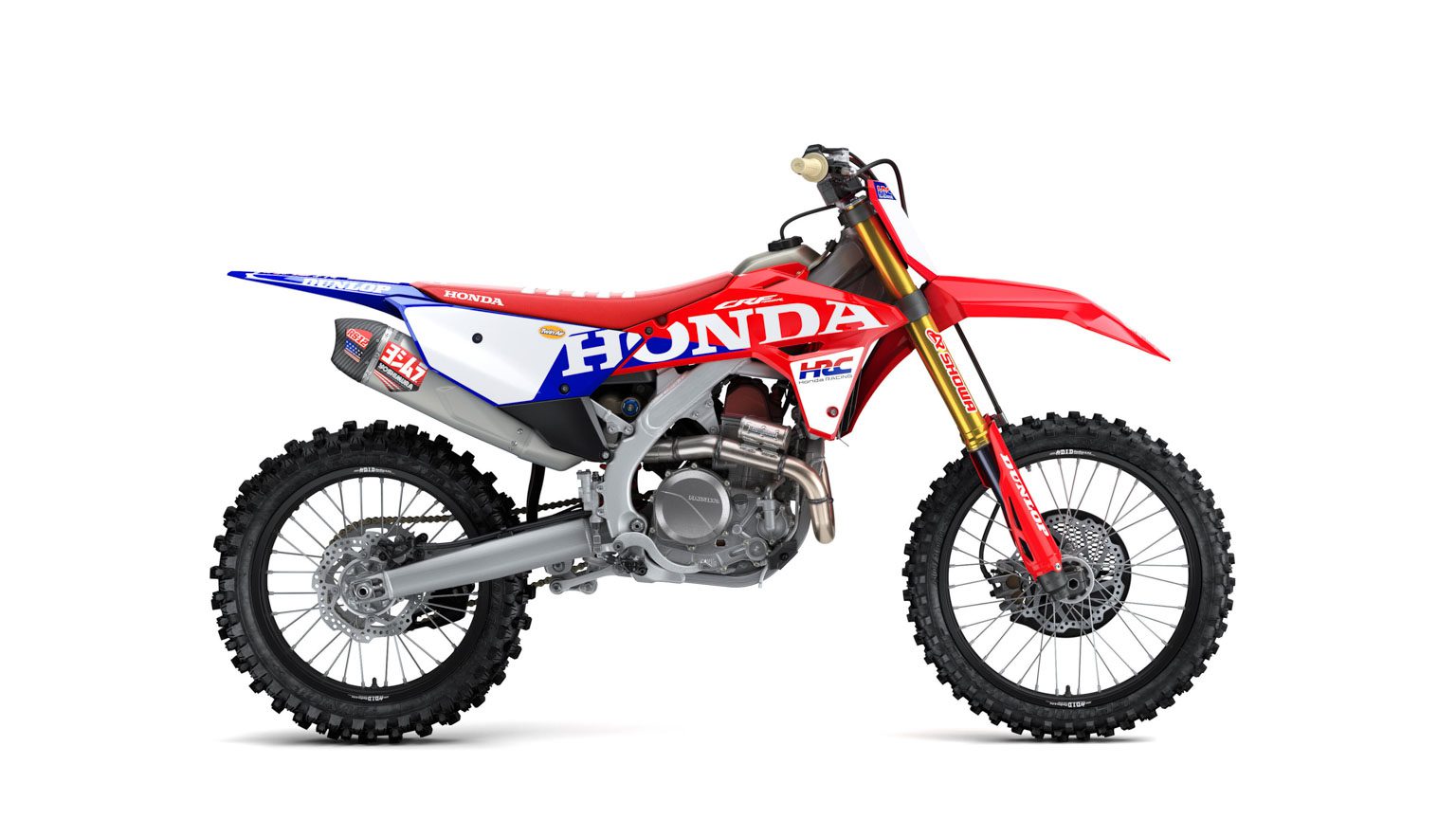
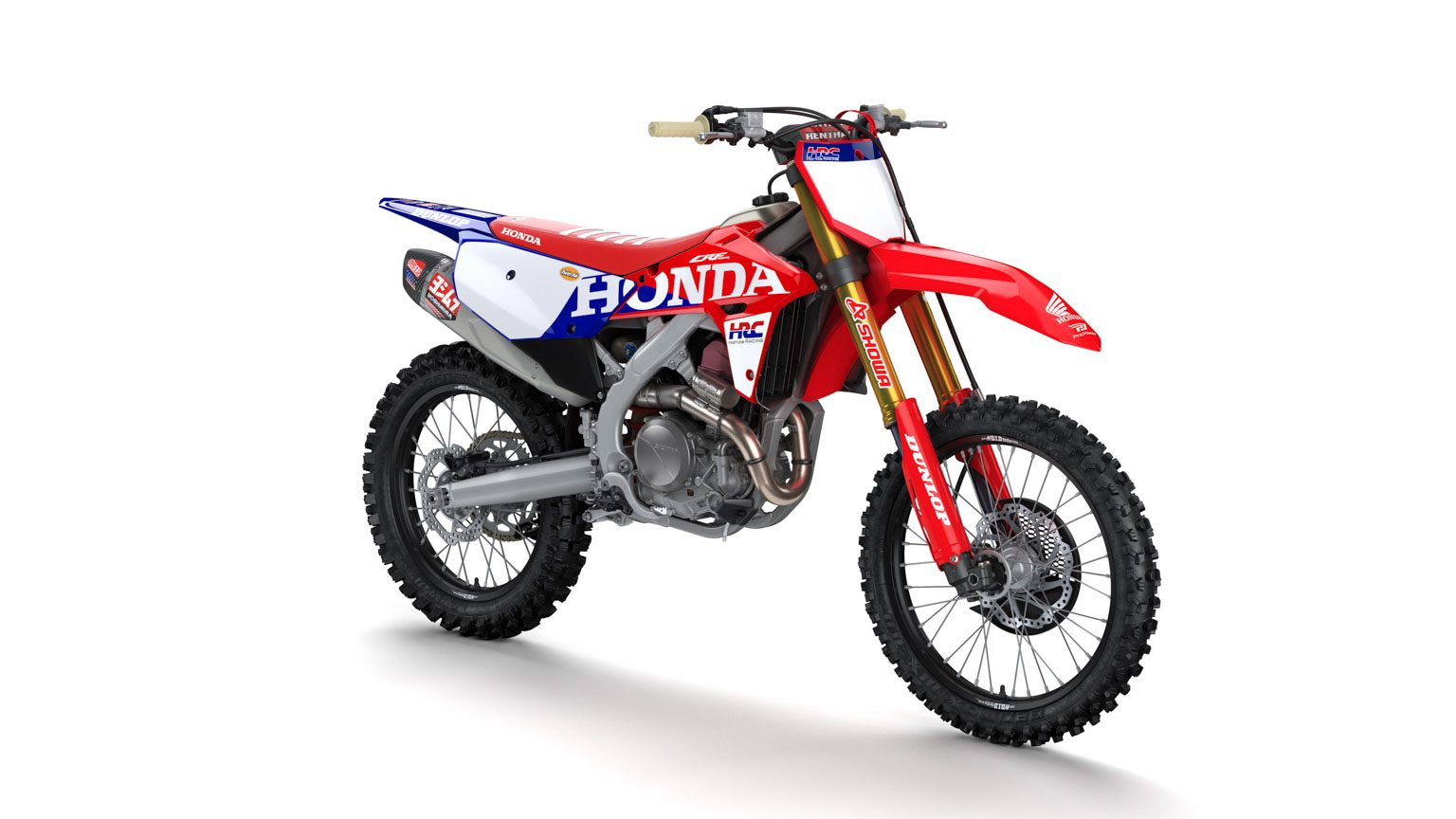
Topping the line-up is the limited edition 27YM CRF450R HRC-WE, which adds Works Edition factory exotica to the standard machine. Hand finished inlet and exhaust ports, plus a new Yoshimura Titanium downpipe/muffler and Twinair filter boost peak power, while exclusive suspension components and cosmetic detailing create a truly special, high-end race bike.
The smaller capacity CRF250R and CRF250RX are updated for the new model year, receiving the same revised graphic package as the 450cc duo for a unified family look and feel, whilst the CRF250RWE is renamed as the CRF250R HRC-WE in keeping with its bigger sibling.
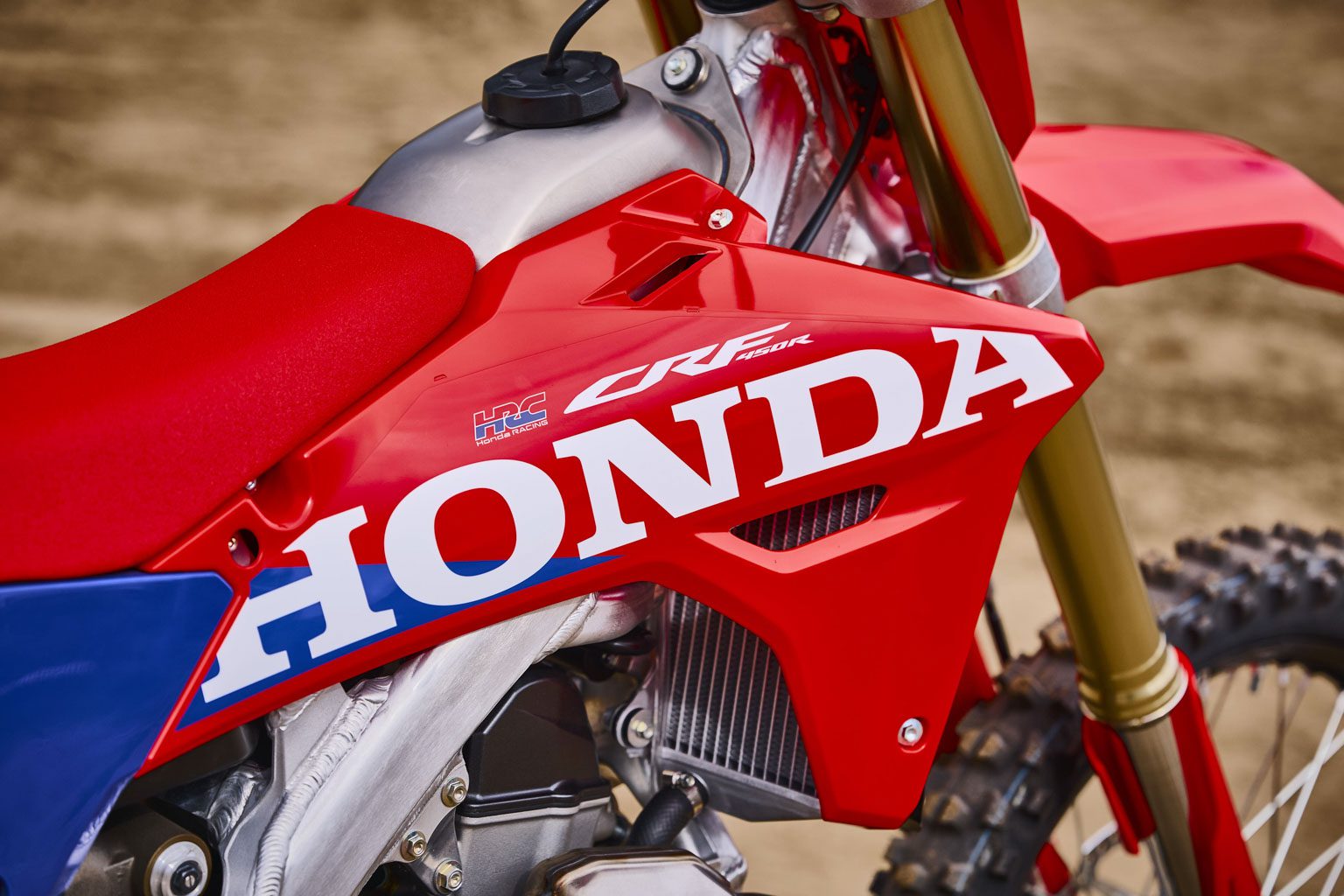
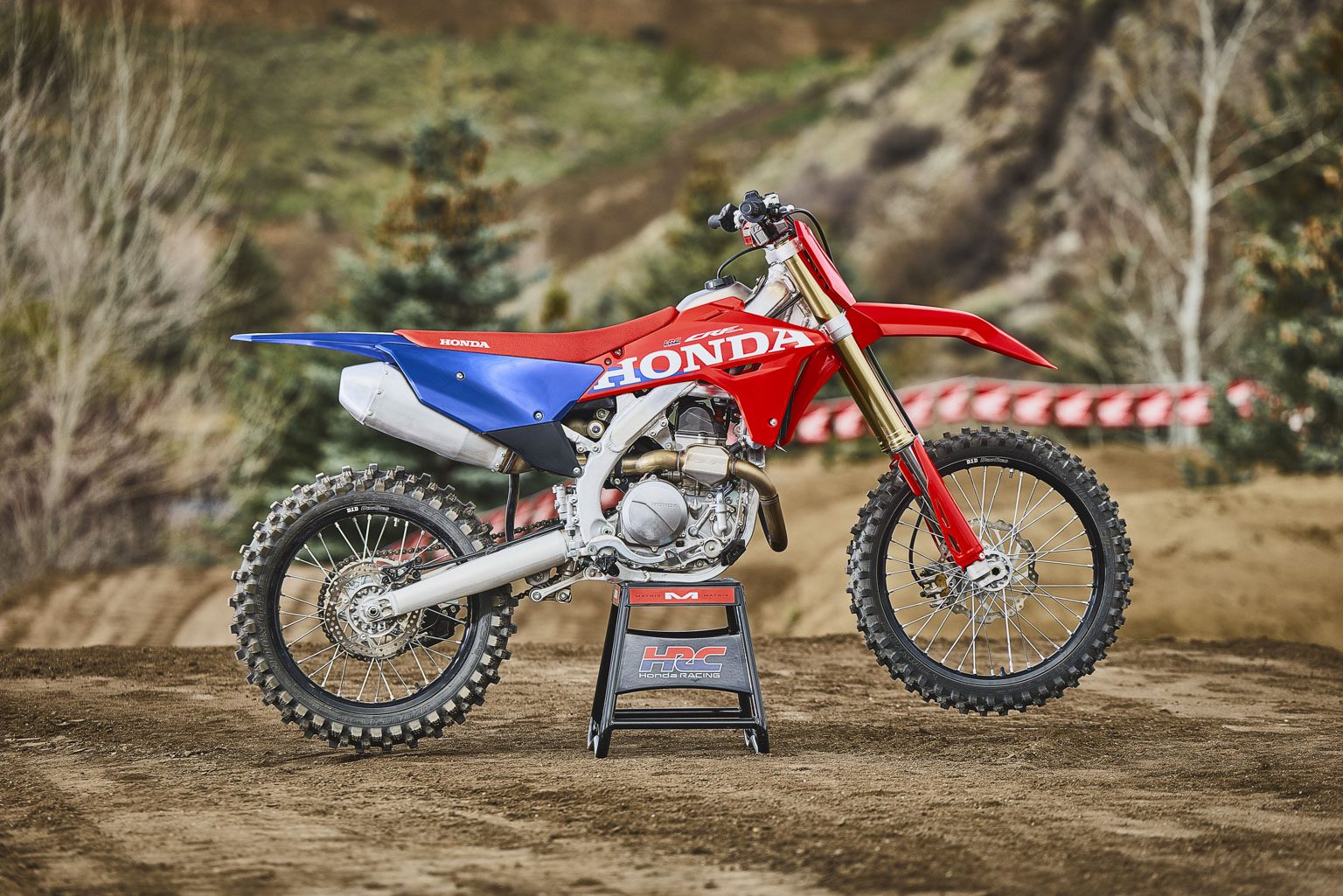
All 27YM CRF models use Extreme Red as their base colour, and feature all-new HRC inspired graphics built around increased application of blue, and an oversized Honda logo that brings consistency across all of Honda’s racing activities – on and off road.
Quick Summary: More power, less weight, sharper handling and increased style – the 27YM CRF450R is improved in every area for the ultimate off-road experience
New Model: Revolution overtakes evolution around the outside – for 27YM CRF450R is effectively a brand-new machine. The biggest overhaul in a decade has seen Honda’s flagship motocrosser updated in every facet. At the heart of the model is an all-new, punchier 449.5cc engine which produces 10.3% more power and 3.7% more torque thanks to a bigger bore, shorter stroke and larger diameter inlet and exhaust valves, plus new piston and crankshaft as well as a higher compression ratio. Paired with a more compact gearbox with revised ratios and an innovative clutch, performance is amplified on any surface. Handling has been sharpened, stability increased, and predictability across even the roughest of track conditions improved by a 70% new frame paired with a new, longer aluminium subframe and completely revised suspension. An updated electronics package fine tunes the performance potential even further, while revised bodywork increases rider comfort.
The stunning CRF450RWE becomes the CRF450 HRC-WE for 27YM, and features select race-derived components and a Honda Racing-inspired livery that further enhance performance and appeal.
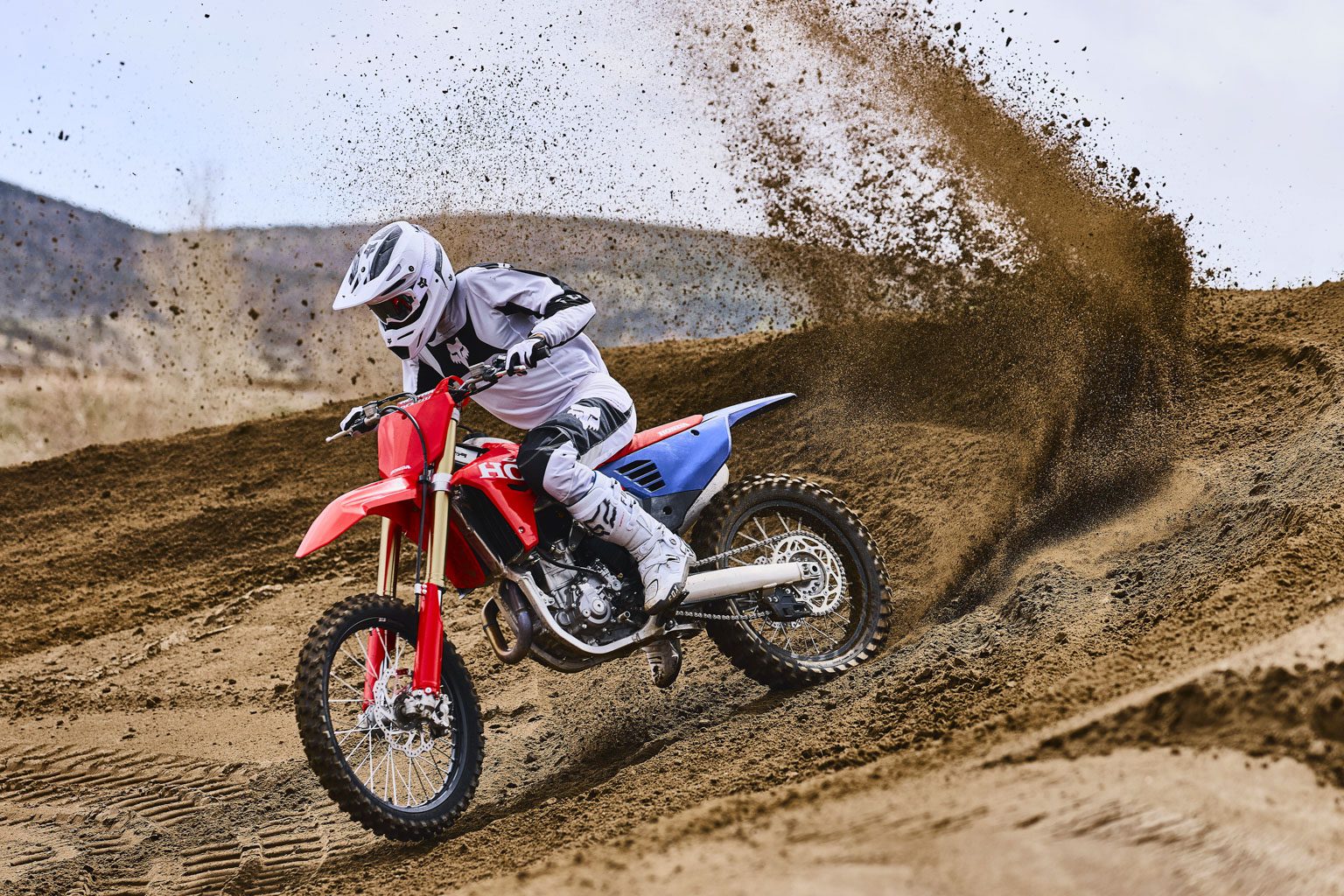
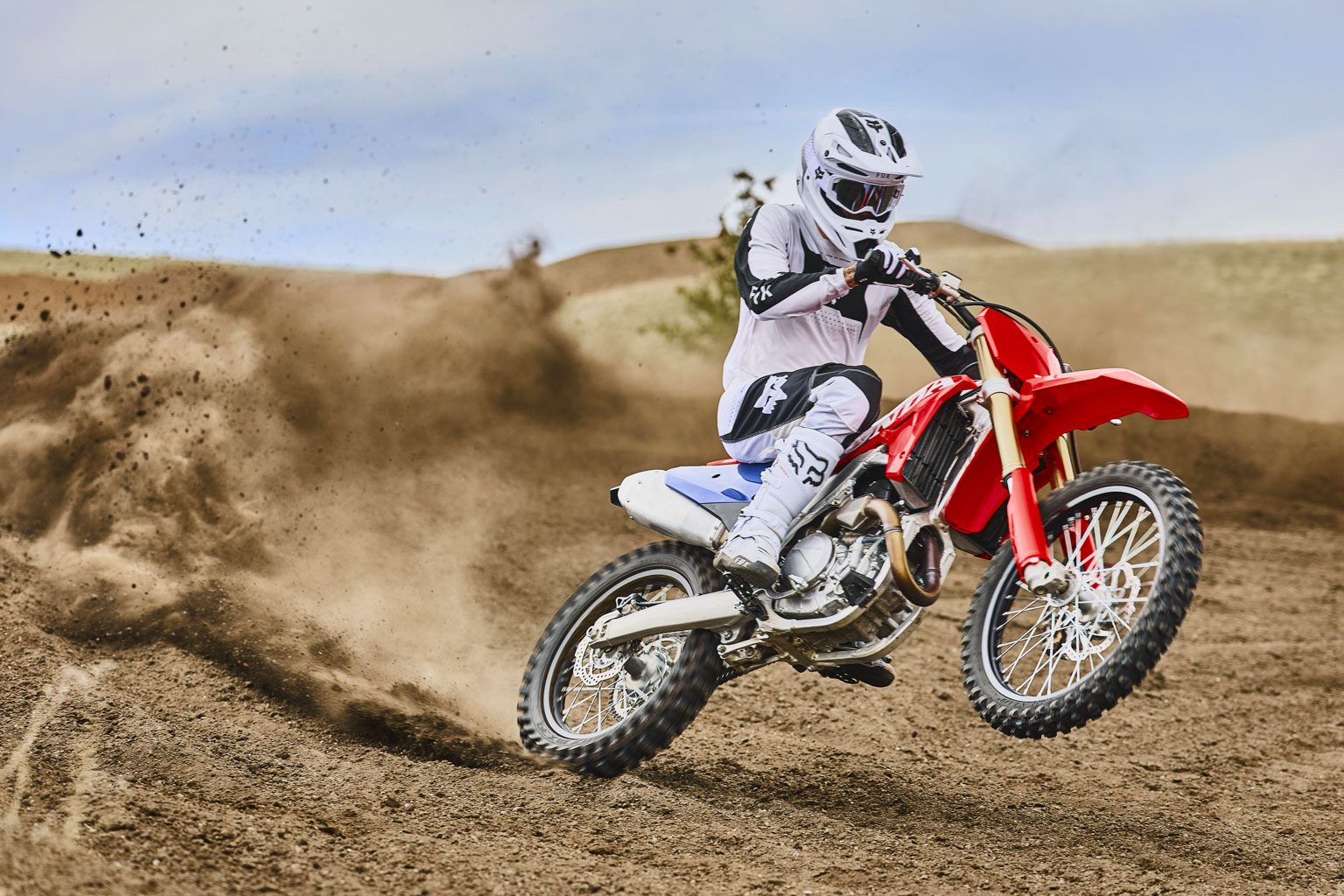
- Introduction
The Honda CRF450R has been the benchmark motocrosser since its introduction in 2002. Its package has always aimed to offer its rider – whether amateur enthusiast or pro-racer – total control through balance and agility. Plus, of course, it’s built with the quality, durability and longevity that Honda has long been famed for.
And it’s a race bike that has constantly evolved. In 17YM, Europe’s favourite open-class MX machine was given a ground-up redesign, with completely new chassis and a major top-end power boost from a brand-new engine. Standard-fit electric start was a convenient addition in 18YM and, for 19YM, an HRC-developed cylinder head upped power and torque considerably; HRC launch control was also added. In 20YM the CRF450R gained Honda Selectable Torque Control (HSTC).
For 21YM, aside from the wheels and the fundamental engine architecture, the CRF450R was effectively a totally new bike, drawing heavily on developments from the 2019 MXGP championship winning CRF450RW. The 23YM machine jumped out of the gate with a host of updates to the engine and chassis, improving and smoothing low-down torque delivery and building front-end grip. Development of the CRF450R has always gone hand in hand with the needs of HRC’s MXGP factory riders and the 25YM CRF450R aimed at making going fast easier on a rough track adding upgraded stability and braking to its turning performance.
For 27YM, evolution has been set aside for revolution. And while it builds on the strengths of the previous model, the CRF450R packs a brand new, much more powerful engine within a redesigned, lighter, chassis matched to a completely revised suspension philosophy to deliver the ultimate off road experience. Every detail of the bike has been gathered through the course of world-class competition.
As it has for 24 years, the CRF450R remains to its core the HRC racer that it is possible to buy.
–
- Model Overview
Every update to the CRF450R is focused on delivering a clearer competitive edge, and the headline numbers reflect that immediately: 10.3% more power and 3.7% more torque, combined with a significant 4.5kg weight reduction to just 102.7kg (without fuel). The result is a machine that accelerates harder, responds faster, and feels noticeably lighter and more agile on track.
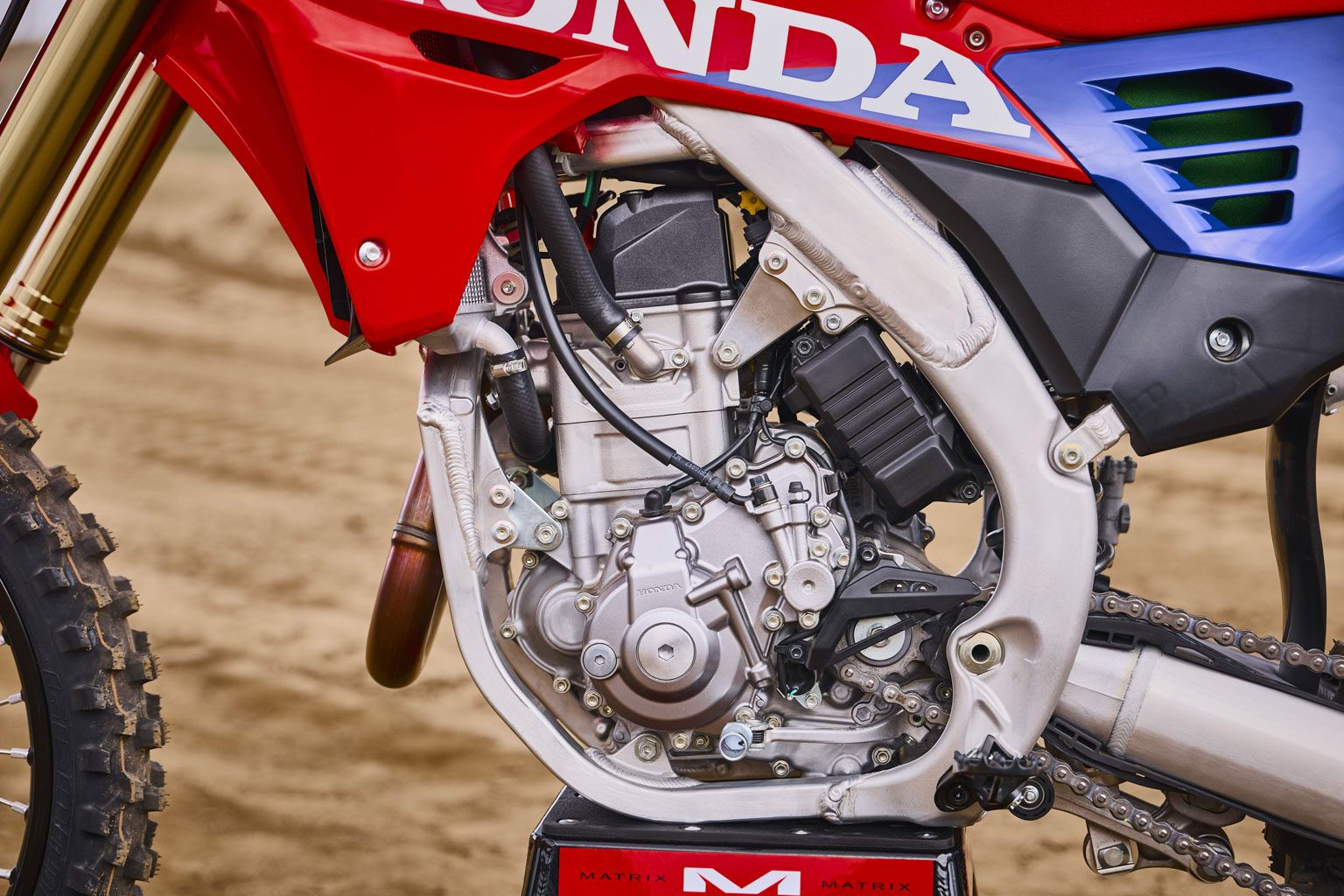
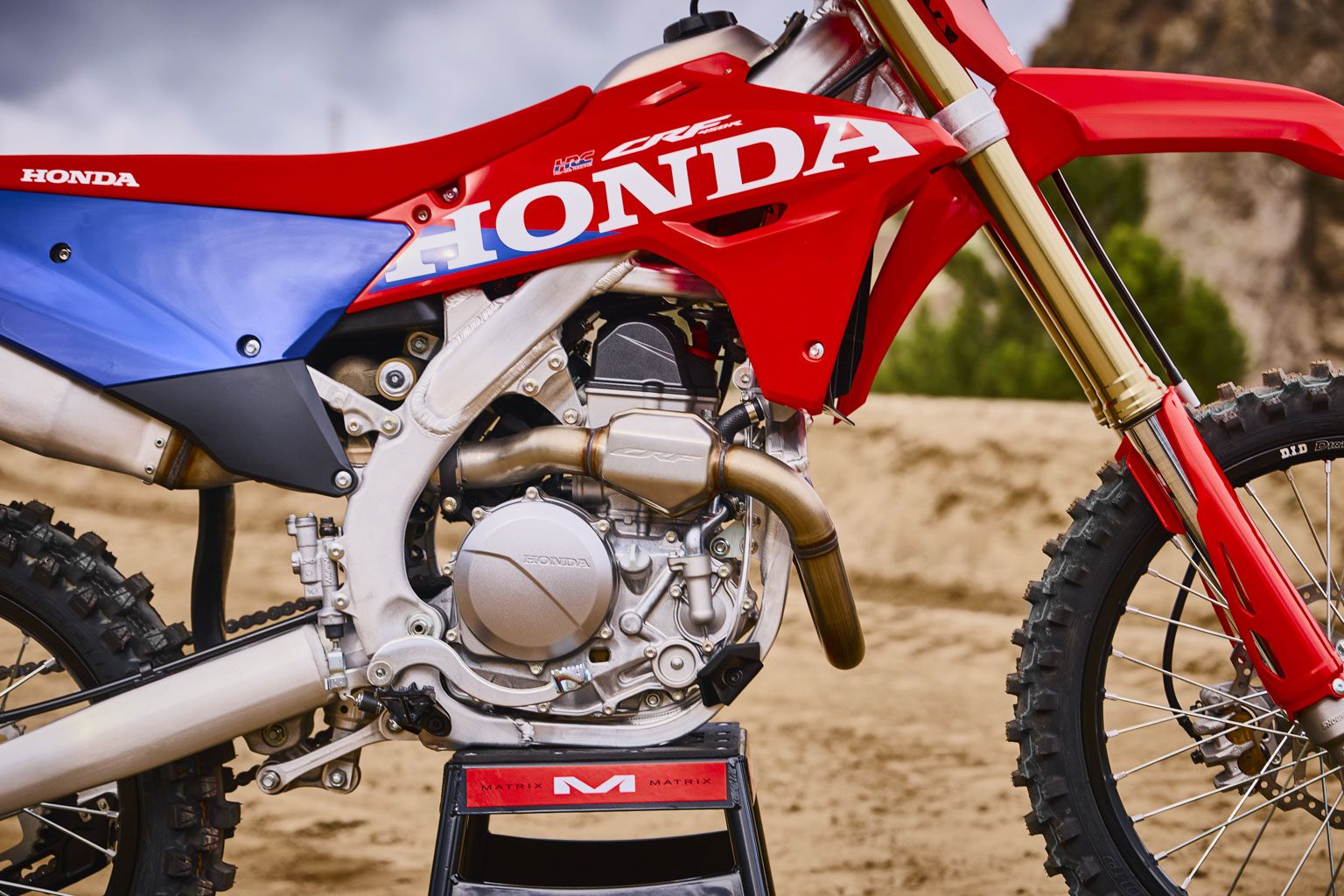
That performance gain starts with a more efficient, harder-revving engine. The redesigned, more compact unit features a larger bore, a new piston with revised crown, and an all-new crankshaft that enables a shorter stroke and higher compression ratio. Larger titanium intake valves join newly introduced titanium exhaust valves, while a reworked UNICAM valve train improves gas flow efficiency, helping the engine breathe better and deliver stronger, more usable power.
Drive out of corners is further improved through a more compact transmission with revised gear ratios, increasing rear wheel thrust across a wider speed range to allow riders to apply power earlier and with greater confidence. The clutch introduces a world-first rubber damper-activated Back Torque Limiter (BTL), bringing refined slipper performance validated by HRC in MXGP, while a redesigned starter motor saves both weight and space.
Control is just as important as outright performance, and the electronics package reflects that. HRC Launch Control and Honda Selectable Torque Control (HSTC) are now updated with settings taken directly from factory race machines, offering sharper, more adaptable performance in changing conditions. The Engine Mode Select Button (EMSB) continues to give riders instant control over engine character, tailoring delivery to suit both rider preference and track demands.
Handling has been sharpened, stability increased, and predictability across even the roughest of track conditions improved by a 70% new frame. New sections, optimized materials and manufacturing processes have increased overall rigidity without increasing weight over the 26YM. This new frame works in harmony with a new, lighter aluminium swingarm that has been shape-optimised not only for performance but also to improve access for air filter maintenance.
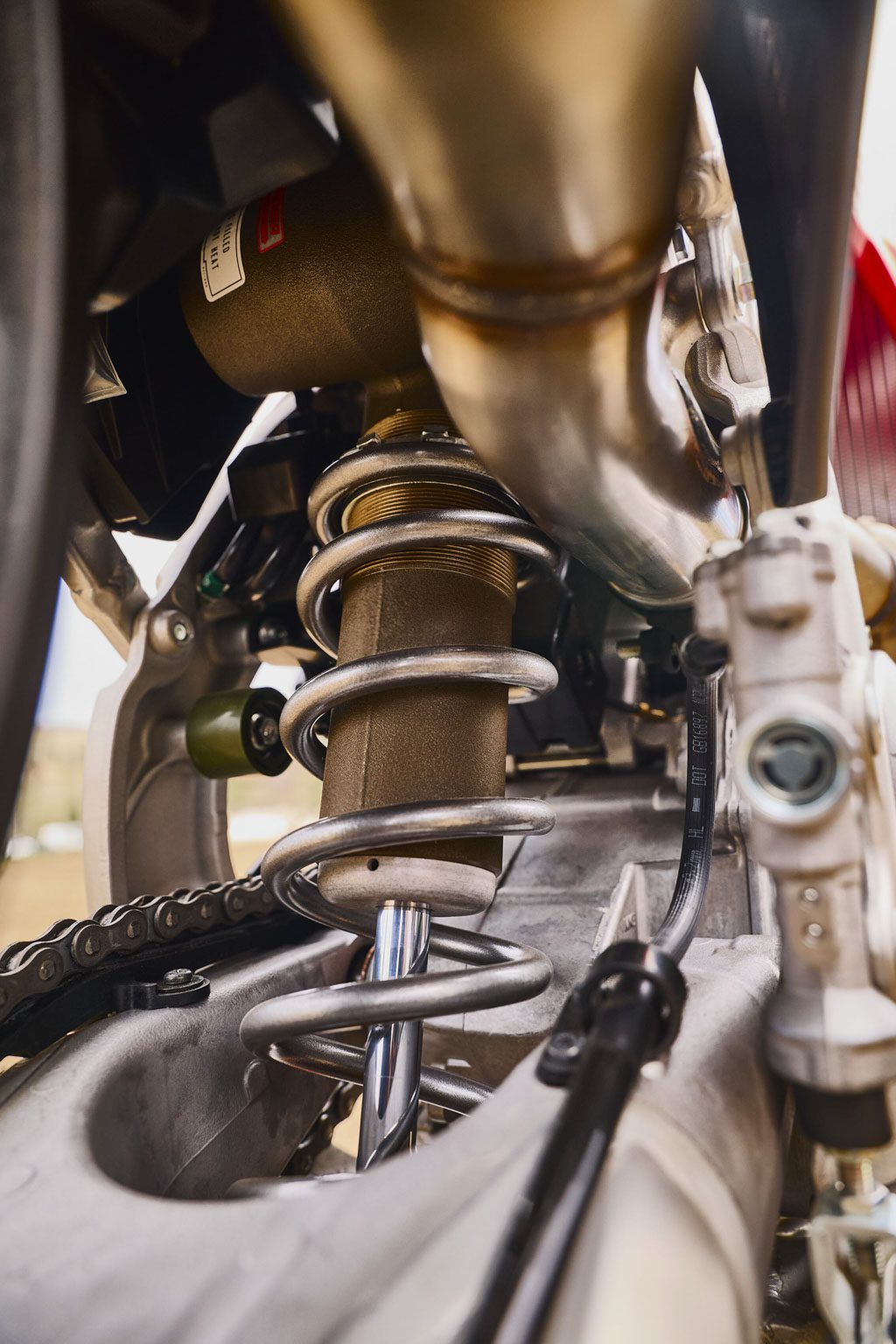
The revised Showa suspension package introduces a refined friction balance front and rear, delivering smoother, more consistent response throughout the stroke, supported by an updated Pro-Link system, a new rear wheel and hub, and a larger Dunlop MX34 rear tyre.
The rider interface has also been refined to enhance both performance and usability. An additional 0.8L of fuel capacity extends time on track, while reshaped radiator shrouds and rear side covers improve rider mobility for better cornering and acceleration. A new seat contour further improves rider connection to the bike. Sustainability is also addressed, with recycled materials now incorporated into selected bodywork, while the iconic HRC Tricolour scheme visually links the CRF450R to Honda’s top-level racing efforts in MotoGP and WorldSBK.
For those seeking an even closer connection to factory performance, the limited edition CRF450R HRC-WE builds on the standard machine with genuine Works Edition upgrades. Hand-finished inlet and exhaust ports, a Yoshimura titanium exhaust system, and a Twin Air filter increase peak performance, while exclusive suspension components and premium detailing elevate the bike into a true race-ready package straight from the showroom.
–
- Key Features
3.1 Engine
- Revised specification represents biggest change to the CRF’s powertrain in over a decade
- New design is 10.3% more powerful with 3.7% more torque across the rev-range
- 2.7kg lighter and more compact with a 17mm reduction in width
- Bigger bore, shorter stroke, larger titanium intake/exhaust valves and new UNICAM valve train
- Redesigned piston, increased compression ratio plus new, more rigid and efficient crankshaft
- Updated intake increases airflow; new exhaust is lighter and conforms to AMA/FIM 111dB regulations
- More compact transmission uses revised ratios to deliver stronger drive force across a wider speed range
- New smaller, lighter clutch with rubber damper activated Back Torque Limiter (BTL) slipper action, validated with HRC in MXGP, is a world’s first application
- Starter unit revised and rationalised to save weight and space
27YM sees a huge update for the CRF450R’s engine in terms of physical size, weight and performance. It’s effectively brand new, more compact, and much lighter. And much more powerful, just over 10.3% at peak – at higher rpm – with 3.7% more peak torque. Bore size has increased 1mm to 97mm over the 26YM design, allowing the use of larger diameter valves – 40mm inlet and 32mm exhaust (as opposed to 38/31mm). Stroke is now set at 60.83mm, from 62.1mm.
A redesigned airbox simplifies and straightens the airflow path into the engine, minimising resistance. The 27YM design also loses the lid of the 26YM design. An air filter with revised density plus a more rounded shape has the same surface area as before but reduces airflow resistance by 10%. New ECU settings provide optimum response and control.
The intake port is also steeper, by 5°, and 10mm shorter while an optimised valve angle further boosts the downdraft intake efficiency, improving both output and drivability – core strengths of the engine. As before, the compact UNICAM single camshaft design offers the wide valve-timing flexibility enabled by finger-follower rocker arms. More aggressive cam profiles are driven by a new, higher rigidity and lighter weight valvetrain with intake and exhaust rocker arm shafts aligned on a common axis.
A new piston crown shape and optimised combustion chamber profile enhance combustion efficiency, and ups compression ratio from 13.5:1 to 13.75:1. A Diamond Like Coating (DLC) has also been applied to the top piston ring, reducing friction and producing more consistently stable operation with superior reliability.
The 26YM engine employed an ‘anchor’ shaped crank web profile; for 27YM a ‘round’ profile replaces it, increasing overall crankshaft rigidity. New journal roller bearings (as opposed to a ball/roller combination) reduce deformation from combustion pressure, converting it more efficiently into rotational energy with reduced friction at bearing and gear engagement points.
The exhaust conforms to AMA/FIM sound regulations (111dB) and is optimised for performance. The new muffler is longer but lighter, 2.76kg rather than 2.91kg. Also, longer is the downpipe, despite it too shaving 53g over the previous design weighing 1.111kg.
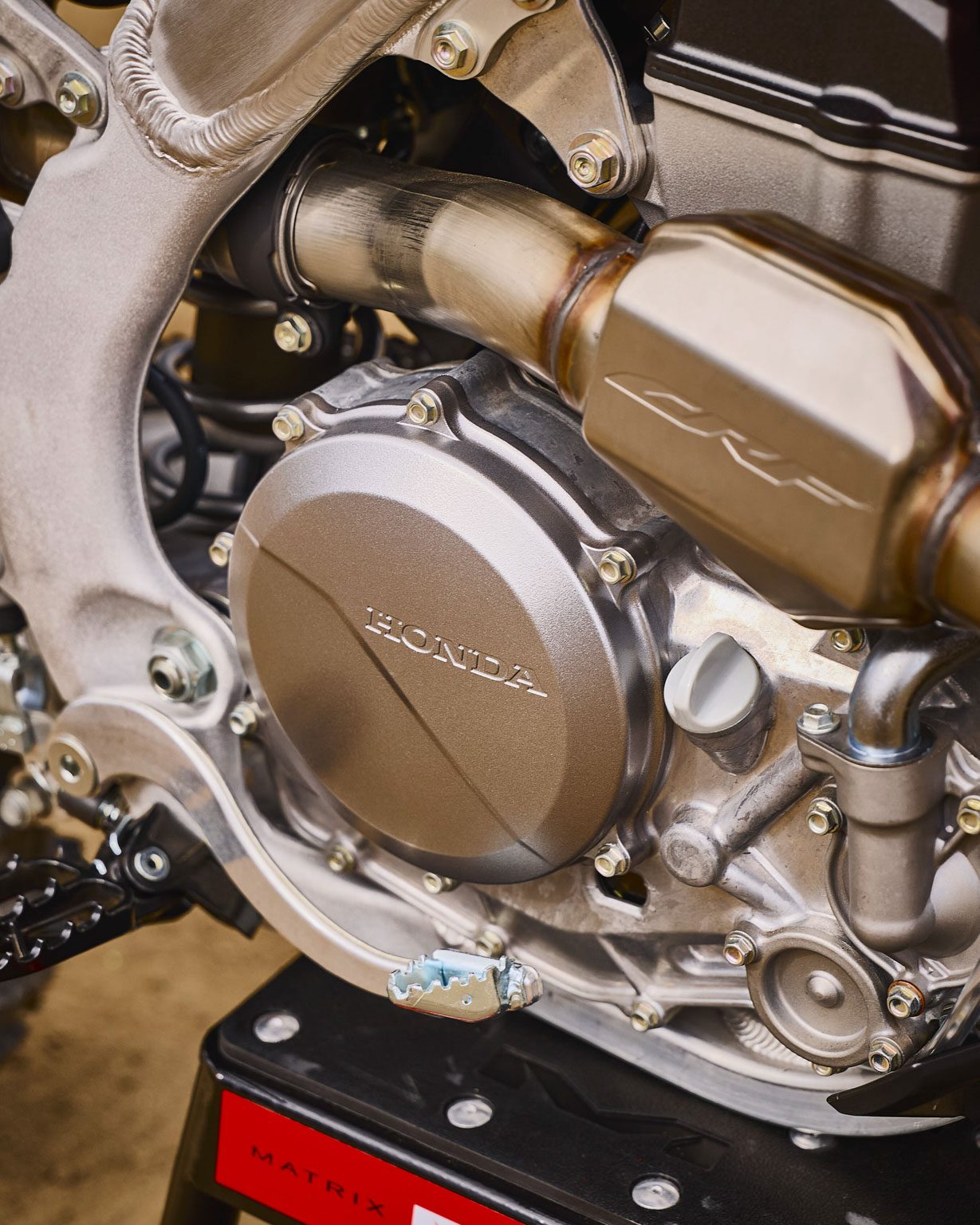
Drawn directly from HRC feedback to optimise inertia and controllability, the clutch is an all-new design, 7mm smaller in diameter at 132mm and 400g lighter. The unified steel construction of the previous primary drive gear has been replaced with a ring-shaped gear, minimising the amount of steel required.
In addition to the conventional clutch rubber function of absorbing and mitigating torque fluctuations, and in a world’s first application, a rubber damper-activated Back Torque Limiter (BTL) adjusts clutch capacity through deformation of the damper as back torque is generated, and acts with a ‘slipper’ function, greatly reducing the rider’s clutch load and improving overall engine manageability. Optimal shaping, structure, durability and limiter-capacity settings were all tested throughout real time MXGP competition.
In the transmission, the main shaft bearing annular collars have been replaced with split resin cage needle bearings, allowing each gear to be optimised for shape, shaft diameter, wall thickness and positioning without being restricted by adjacent gear geometry. As a result, overall transmission width has been reduced through utilisation of a 14mm shorter transmission shaft, which also nets a 509g weight saving.
The shift drum itself is also 134g lighter than before and, at 63.5mm, 13.4mm shorter in length. The weight reduction has been achieved by using a higher-tensile material for its construction, which allowed for the drum to have thinner walls. The smaller size has been achieved by reducing the shift drum’s lead grooves from 3 to 2.
To match the boost in engine output, revised gear ratios (see chart) and 51 tooth final drive sprocket (increased by 2 teeth) deliver much more driving force, across a wider speed range.
Also redesigned – and 500g lighter – the starter system now operates through a 4-axis configuration (down from 5) and uses a lightweight friction-disc torque limiter rather than a press-fit design. The starter one-way clutch is smaller in size with a lighter weight outer structure.
The new lighter and more compact transmission, clutch and starter have allowed optimisation of the surrounding components; net result is a 17mm reduction in engine width and a 2.7kg mass saving compared to the previous design.
–
3.2 Electronics
- HRC Launch Control updated with settings from feedback of the factory competition bikes
- Honda Selectable Torque Control (HSTC) also optimised for upgraded engine performance
- Engine Mode Select Button (EMSB) features 3 maps to adjust output character
HRC Launch Control has been tuned to match the increased engine output, with new settings drawn from feedback of the factory competition bikes. As before there are three modes, and each ‘waiting’ rev limit offers good start potential with maximum drive/minimum wheelspin. After starting, the rev limit returns to normal.
- Mode 1: High waiting rpm, then returns to normal immediately
- Mode 2: Slightly lower rpm than Mode 1, returning to normal immediately
- Mode 3: Low waiting rpm and gradually returns to normal in a few seconds.
HRC Launch Control can also be switched off completely.
The HSTC works to minimise rear wheel spin (thus reducing wasted forward drive) and maximise traction. It doesn’t use a wheel speed sensor and critically maintains feel at the throttle while managing power; ignition timing is retarded and the PGM-FI controlled when the rate of change of rpm is detected to have gone over a set amount.
Three modes differ in drive management level for different riding conditions:
- Mode 1: Intervenes most lightly, and after the longest time – offering high wheelspin
- Mode 2: Naturally offers a mid-point between 1 and 3 in terms of speed and strength of intervention and maintaining control in tight corners
- Mode 3: Has the system intervene more quickly and strongly, with low wheelspin, and is therefore useful in more slippery, muddy conditions
HSTC can also be switched off completely. When the engine is turned on, the system uses the last-selected setting.
There are also three modes available via the Engine Mode Select Button (EMSB) to alter engine character. Mode 1 is the standard setting, 2 smooth and 3 aggressive.
The Launch Control indicator, EFI warning, HSTC and EMSB mode button, and LED indicator are sited on the left handlebar. Pressing and holding the HSTC button for 0.5s will cycle the system to the next mode, with a green LED indication – 1 blink for Mode 1, 2 for Mode 2 and 3 for Mode 3 – to confirm selection.
–
3.3 Chassis
- 70% new main frame with increased rigidity around the head pipe thanks to a, now, cast head pipe gusset
- Kerb weight of 108kg, 4kg lighter
- Brand new, lighter aluminium swingarm
- Completely revised suspension front and rear builds smooth, consistent control everywhere in its stroke
- New Pro-Link linkage ratio smooths corner exit
- New 19in rear wheel and axle feature increased rigidity for improved drive, rear tyre up in size
Built around the goal of boosting stability, cornering performance, rear drive and overall traction, the new chassis’ base dimensions and rider position have been revised for 27YM. Wheelbase increases from 1482mm to 1490mm, with rake going from 27.3° to 27.5° and trail 115.3 to 116.7mm. The footpegs move 5mm rearward, and the rear axle downward offset decreases, whilst weight distribution moves slightly forward for a more balanced split.
Ultimately, the new CRF450R is now a full 4kg lighter, with a fuel-free mass of 102.7kg and ready-to-go kerb weight of 108kg (from 107.2kg/112kg).
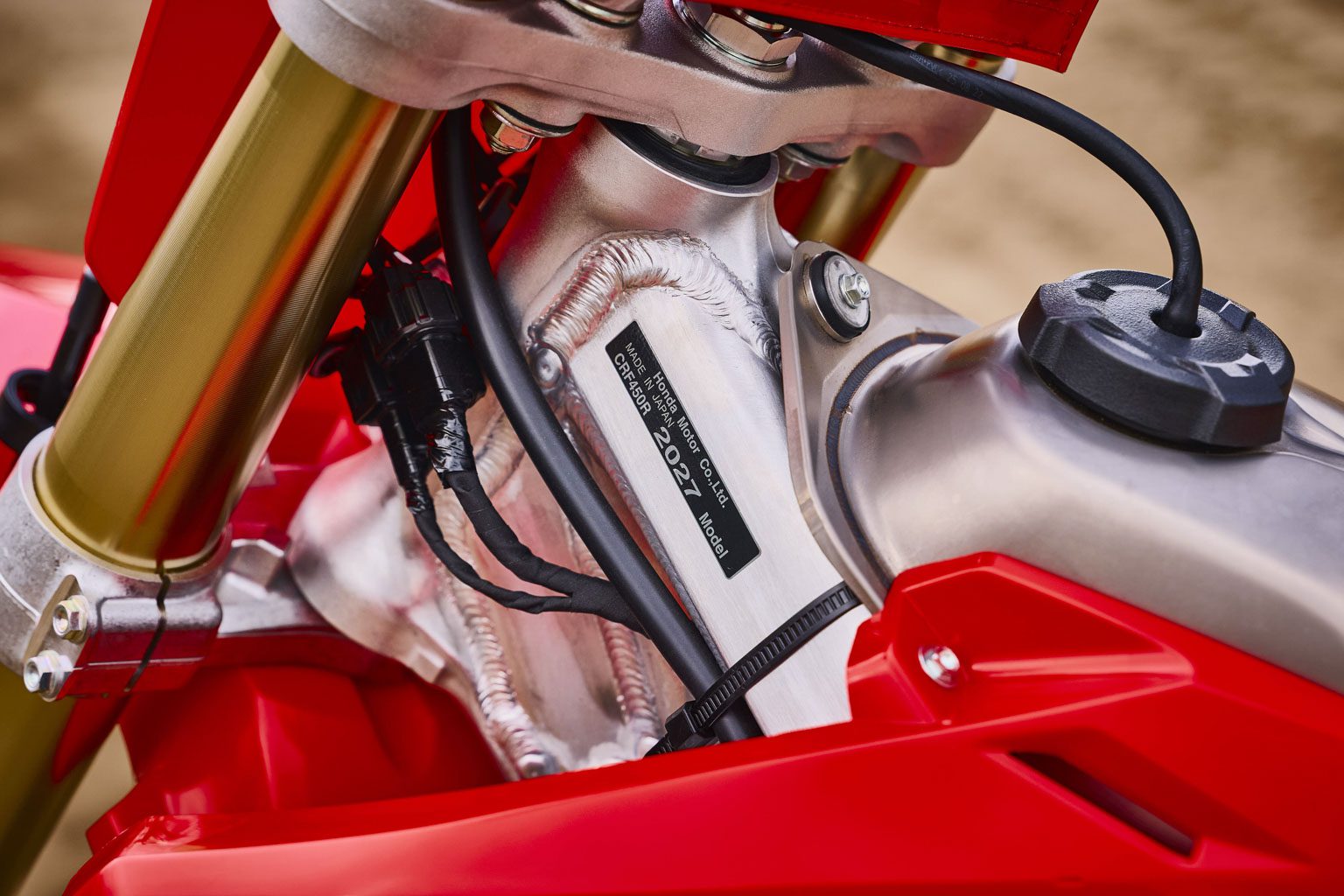
The twin-spar aluminium main frame features a 70% redesign, with the aim of enhanced stability and predictability on the roughest of track conditions. Up front, the head pipe – adjusted for the new rake angle with an upsized cast, rather than forged gusset – down tube and front joint are optimised for rigidity and weight. As a result, longitudinal and torsional rigidity of this area increases 10%, with zero increase in weight over the 26YM model.
Also optimised for rigidity and shape are the swingarm pivot plates, shock absorber upper bracket and subframe mounting brackets. The cylinder head hanger plates – now constructed of aluminium instead of steel – are 152g lighter. As the engine is now more compact, revised lower down tubes and middle hanger brackets have been applied. The rear subframe employs a simplified design, making space for easier air filter maintenance.
The smoothly blended weld design between the cross-member and main pipe creates a more continuous structure, allowing the use of larger-diameter, thinner-wall tubing for improved stiffness and lower weight; ultimately saving 415g in total. Each spar is now a smooth D-shape in cross section, improving rut riding ability. For 27YM, the swingarm is now marginally longer than before. On an aesthetic level, for the first time in 7 years the look of the swingarm’s twin main spars has been refreshed. The smooth, step-free design is meticulously hand polished into hairline finish, and utilizes evenly patterned fish scale weld for a premium finish.
Upper/lower reinforcement of the chain slider and addition of a damping hole improves drive, while the guide plate structure uses Dakar-derived technology and a high-impact resistant resin material, reducing deformation under impact loads.
To reduce ‘kickback’ and improve ride comfort and stability under acceleration, the Pro-Link linkage ratio has been adjusted. Thrust needle bearings have also been adopted (replacing thrust washers) in the link arm, enhancing smoothness with improved feel for traction.
The development aim of the 27YM machine’s Showa suspension was to build on the success of the 26YM design, with reduced front/rear pitching under acceleration/braking, and improved stability. And, in fact, to grow a real advantage as track conditions get tougher.
Also, the philosophy has changed from the 26YM machine. Before ‘low friction’ was the over-riding target; for 27YM this has changed, with a considered amount of friction added to the suspension stroke, from the initial movement. This has been achieved by completely upgrading the 49mm USD forks, with the main damping force now coming from a Dynamic Blow System (DBS) piston; this change increases compression damping in the extremely low to low-speed range, improving stroke consistency. Compression and rebound damping at both ends have been increased without introducing any harsh, or negative characteristics.
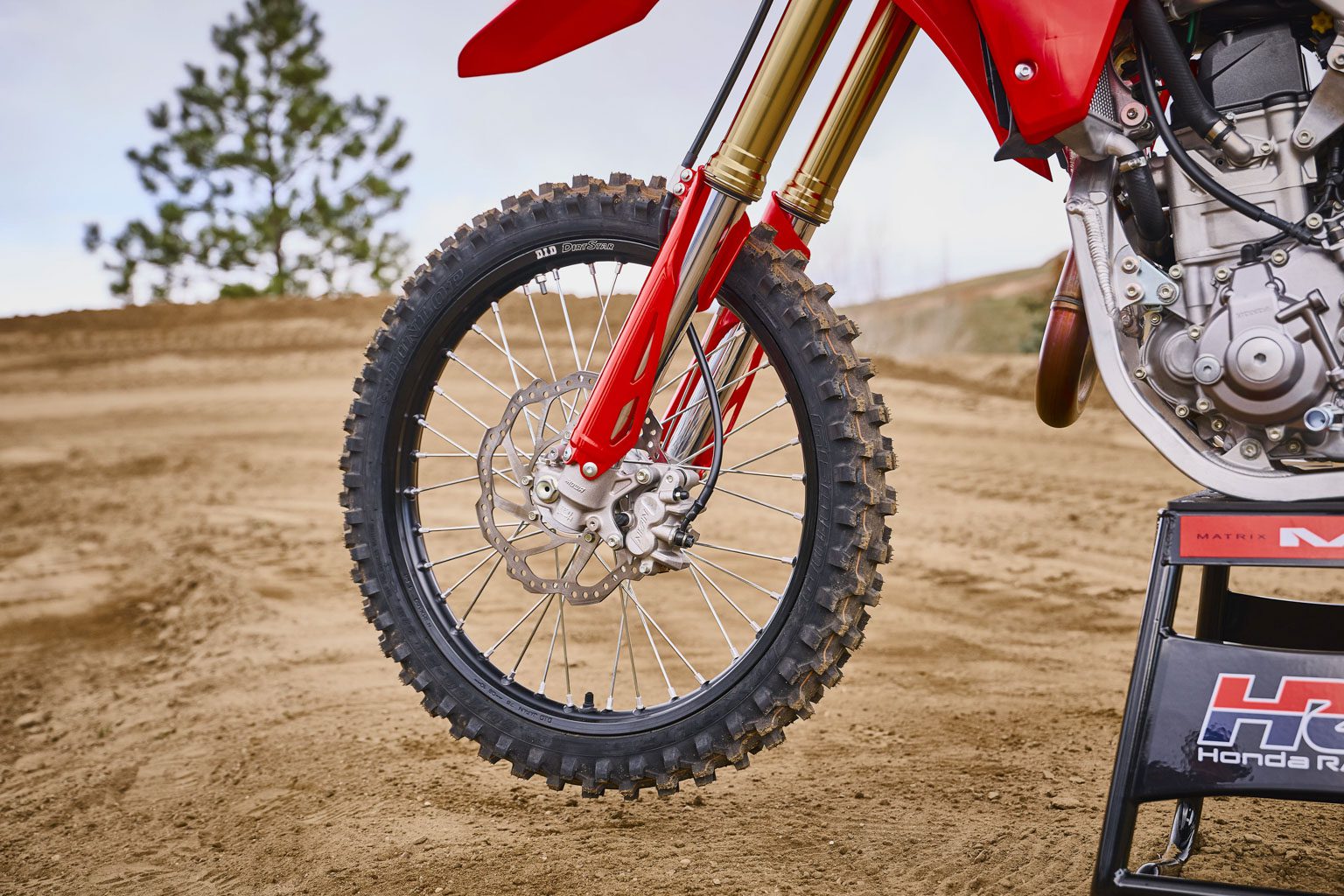
Further elevating smooth control with consistency factory-spec, Kashima coating has been applied to the rod and cylinder. As a visual clue to the premium upgrade, the fork cap sub tank also receives Kashima coating.
A fine detail – but very much an HRC update – is application of a dedicated seal for the steering stem resulting in careful friction management of the steering characteristics, adding to the chassis’ overall improvement in stability.
The 50mm single tube rear shock too has been redrawn; 40g has been shaved by careful internal machining of the damper casing underscoring the granular level upgrades Honda engineers have undertaken with the 27YM CRF450R. This is paired with an increased piston oscillation range and revised bump stop, which allows for a wider operating window for the damper stroke, increasing stability and improving the rear wheel contact patch, ultimately improving traction.
To ensure optimal rider comfort, the standard-fit, lightweight Renthal Fatbar are housed in a top yoke that features two handlebar-holder locations to facilitate forward and rearward adjustment by 26mm. When the holder is turned 180°, the handlebar can be moved an additional 10mm from the base position, resulting in four unique riding positions.
Drawn from parts employed by HRC’s bikes the two-piston front brake caliper uses pistons and piston seal grooves that reduce lever play when caliper temperature is high. The caliper itself reduces rigidity change when hot, improving brake lever linearity and reducing rider fatigue. The 260mm wave-pattern disc is unchanged; a single-piston rear caliper is matched to a 240mm wave-pattern disc.
DID aluminium rims, with a directly attached spoke pattern layout are finished in black; the front is a 21 x 1.6in, while the rear 19 x 2.15in wheel is an all-new design created with feedback from the HRC Factory bikes for a 270g weight reduction, increased strength, improved serviceability and enhanced riding performance.
An increased bearing span of the rear wheel hub increases wheel rigidity and reduces axle deformation, while an updated spoke diameter and revised lacing pattern increases traction, optimises roll direction rigidity and extends spoke life. A stronger rear drive sprocket is result of an increase in mounting diameter – from 153 to 160mm. Upgraded to a fully machined part the 51-tooth sprocket also features a redesigned lightening hole pattern.
Dunlop’s MX34F/MX34 soft-terrain tyres are fitted as standard equipment, with the rear up in size to 120/90.
–
3.4 Styling
- Titanium fuel tank now holds 7.1L
- Redesigned radiator shrouds and side covers reprofiled to aid rider position when cornering and accelerating
- Simplification of maintenance throughout the bike
- New graphics display HRC’s Tricolour, linking Honda’s racing activities across MXGP, WSBK and MotoGP
- Sustainable recycled materials used for bodywork manufacture
Overhauled for 27YM, the CRF450R loads with new dynamic bodywork and livery. The shrouds and side covers have been updated to facilitate a flat knee trajectory, front to back of the machine, and the side covers are now symmetrical in shape, improving the rider’s gripping power when the rear is fully loaded under acceleration. The seat contours have changed to match, with a smaller radius at the rear, and height now down 953mm (down from 957mm).
The slim titanium fuel tank has been tweaked to now hold an extra 0.8L at 7.1L. Also redesigned for lightness is the minimal skid plate that protects the underside. Minimal bodywork aids rider movement around the machine.
Up front, the shroud front corners have been made larger in radius to improve lateral movement while cornering seated. Many areas of access have been simplified, for easy maintenance. New graphics – merging the HRC Tricolour and Big HONDA logo – unify the Honda Racing brand across on and off-road.
And, as part of Honda’s aim for zero environmental impact by 2050, the front mudguard, number board and radiator shrouds are constructed using Post Industrial Recycling (PIR) material. Made up of a special selection of highly transparent recycled raw materials PIR delivers high weather resistance and high gloss finish. The seat base, too, is made from high impact PIR.
–
- CRF450R HRC-WE WORKS EDITION
For 27YM the CRF450R HRC-WE evolves the CRF450RWE into a very special race-derived machine. Benefitting from all the model upgrades of the 27YM CRF450R, the HRC-WE features additional parts that enhance both its performance and appeal.
Built alongside its sibling in Kumamoto, the HRC-WE features a Yoshimura muffler matched to new lightweight titanium Yoshimura downpipe and TwinAir air filter, to improve engine breathing.
The intake/exhaust ports of the HRC-WE cylinder head are hand-finished by specialist engineers in the Kumamoto factory to remove any small steps in the port created in the casting process. ‘CRF WORKS EDITION’ is laser-engraved on the cylinder head to reinforce the engine’s status. Revised ECU settings – including exclusive ignition timings and unique start modes – ensure the HRC-WE makes considerably more power than the standard CRF450R.
Up front the USD forks wear anodised/laser stamped hand compression adjuster and fork caps, matched to anodised black axle clamps. The rear shock features a titanium coated rod for improved wear resistance and rear wheel control, plus new Metallic Red colour for the spring. Suspension settings front and rear are optimised for the HRC-WE.
The CRF450R HRC-WE also features a striking Metallic Red cylinder head cover, black top and bottom yokes, gold DID DM2 chain, Renthal bar grips, Throttle Jockey seat cover, black DID-LTX wheel rims, and updated 27YM graphics.
–
- Technical Specifications
27YM CRF450R
27YM CRF450R HRC WORKS EDITION
ENGINE
Engine Type
Liquid-cooled 4-stroke single cylinder uni-cam
Engine Displacement
449.5 cc
Bore x Stroke (mm)
97.0 mm x 60.83 mm
Compression Ratio
13.75:1
Oil Capacity
1.23L
Starter
Electric Starter
FUEL SYSTEM
Carburation
PGM FI
Fuel Tank Capacity
7.1 L
ELECTRICAL SYSTEM
Battery Capacity
2.3Ah
DRIVETRAIN
Clutch Type
Wet type multi-plate
Transmission Type
Constant mesh, 5-speed manual
Final Drive
Chain
FRAME
Frame Type
Aluminium twin tube
CHASSIS
Dimensions (L´W´H)
2,200 x 827 x 1,263 mm
Wheelbase
1,490 mm
Caster Angle
27°31′
Trail
116.7 mm
Seat Height
953 mm
Ground Clearance
333 mm
Kerb Weight
108 kg
107.9 kg
SUSPENSION
Suspension Front
Showa 49mm USD fork
Suspension Rear
Showa 50mm monoshock with Honda Pro-Link
WHEELS
Wheels Front
Aluminium HUB
Wheels Rear
Aluminium HUB
Tyres Front
80/100-21 51M DUNLOP GEOMAX MX34F
Tyres Rear
120/90-19 66M DUNLOP GEOMAX MX34
BRAKES
Brakes Front
Single 260mm disk
Brakes Rear
Single 240mm disk
INSTRUMENTS & ELECTRICS
Additional Features
HSTC, HRC Launch Control, Engine Mode Select