
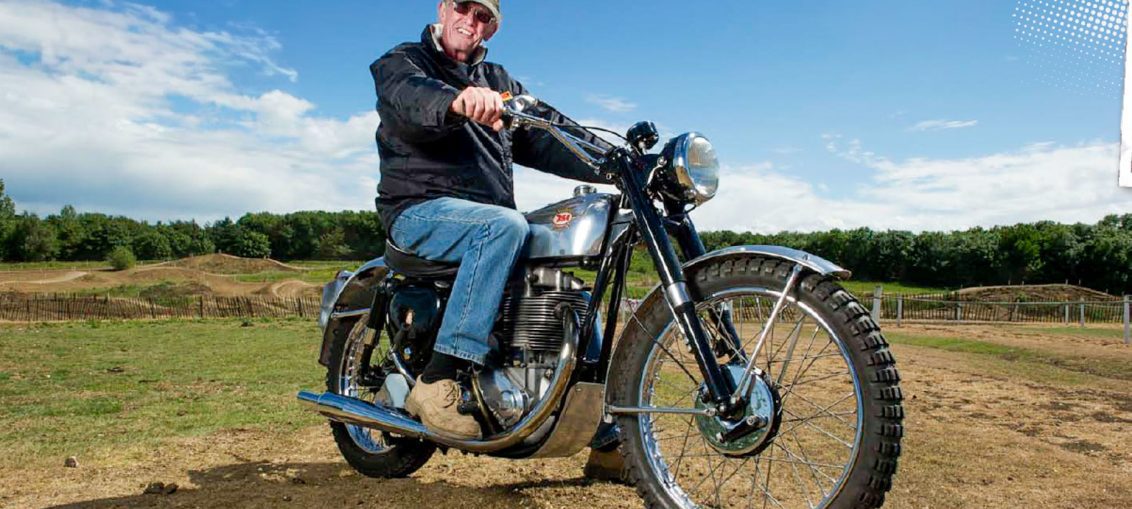
Former factory racer and the man who changed the face of British motocross circuits Andy Lee has passed away as he entered his 90th year. As a tribute to the great man, here’s an interview we did with him back in 2011 when he was a spritely 76!
It’s difficult to know where to start with the contribution to motorcycling made by Cambridgeshire’s Andy Lee. Now aged almost 76 (NB This was in 2011), he’s been involved with motocross right from its infancy.
A former BSA and matchless factory rider, he pioneered the way as one of Europe’s first full-time professional motocross racers. He only retired from full-time racing aged 45!
He owned a huge motorcycle shop through the 1970s and 80s boom years of the sport. And even his son Michael was immensely talented, becoming world speedway champion.
But probably the biggest impact he’s had is on British circuits themselves. By turning his beloved Elsworth circuit from a bumpy field into Britain’s first dedicated motoparc, complete with mad-made jumps, whoops and tabletops.
His vision of how motocross racks should be had paved the way for every track in Britain.
When many people are retiring, Lee still works on his track every week in summer to ensure it’s in tip-top shape. And best of all, it’s the circuit where he started his racing career a staggering 59 years ago!
We got him together with a beautifully restored version of a BSA Gold Star – the bike that kickstarted his pro career – on the track he’s run for decades to pick his views on life as a pro racer and track owner.
My Dad wasn’t keen on me racing!
I started riding when I was 14 on a bike that cost £15. My first race was here at Elsworth, in the 1952 Cambridgeshire Grand National and I rode on a Francis-Barnett. You had to have a letter off your father to say they understood the risks. My Dad was a civil servant and wasn’t too keen on my racing. But I won the 250 race and I got noticed by a local firm King and Harpers who sold cars and were very big. I was lucky to have gone to school with the son of one of the directors and they gave me a BSA Gold Star to add to my Francis-Barnett.
Being expelled from school formed my career.
I used to ride round the fields on my bike and I made my mind up that’s what I wanted to do. I got expelled from school from spending sports afternoons messing around on bikes and they found out. It was bad news for my Dad as it was a very posh school and he’d paid for me to go. The Perse school in Cambridge (It’s currently £14,000 a year to go there!). I got slung out just before my exams which caused a lot of problems as I had to earn a living. But I went into the forces age 17, and King and Harpers continued supporting me and I did some local meetings. I came out at 19 and I continued doing quite well locally and in centre meetings, and then I got noticed by BSA who fixed me up with a works bike.
Matchless wasn’t a match for BSA!
I was fortunate to have the BSA ride but didn’t realise it! I got into some national meetings. Then Matchless Motorcycles wanted to sponsor me and I did a very silly think and agreed to ride them. Being a bit young I thought it was a progression but they weren’t as good as BSAs. I did two years on the factory Matchless machines and got some good results but I used to break them regularly. Amazingly King and Harpers asked me to come back and ride BSAs again.
France made me what I am.
I had the opportunity to go and ride a meeting in France. At that point I’d never even been out of the country and I was replacing a very famous rider called Brian Stonebridge who was a brilliant man. He rode in the British team for the Motocross des Nations. He taught me a lot about my riding skills and off I went. Unbeknown to me I was on the same contract as Brian Stonebridge. I didn’t really know anything about anything.
I went with a guy from the Eastern Centre called jack Hubbard who was a good centre rider. We went in his vehicle and I finished second overall. I won two races and got a puncture in the third but still finished. The prize money was around £200 but that was in 1956. I guess that would be the equivalent today of around £1200. I went to collect my money and thought there was a clue here in what I should be doing! I wanted some more of that!
It wasn’t difficult to get meetings. France is a big place but there were a lot of international meetings on. As soon as I started riding there I loved it. I seemed to fit in there. I did a lot of racing in Normandy and they were often quite wet and I loved riding in mud. I got some pretty good results and the contracts to race got better and better. I had 32 contracts to race a year.
I never cared for GPs.
There were GPs on and a Eueopean championship, which Les Archer won and Dave Bickers on the 250. But once I was settled racing in France, they were looking after me so well and I was enjoying racing internationals so much, GPs didn’t register with me. Why would I do GPs? I wanted to race in France, Belgium, Spain, Holland. I think I was out to prove myself to my Dad who said: “You’ve messed your schooling up, you’ve made your own bed now go and lay in it.” So I did and I think it worked out.
I did some GPs and did OK but I never went with the intention of doing well. I was too commercially focused! There were a few offering start money. I rode in the first 500 GP in Spain in 1962 in a heatwave and they offered me a small fortune to ride as they wanted to get their GP going. The didn’t understand that the top riders would go for virtually nothing as they were doing the series. It was the year Jeff Smith won from Tibblin. I was fifth and was happy at that. I did the Danish GP in deep sand and surprised myself with fourth. I hooked on the back of Sten Lundlin, the world champ, in one race. And I thought if he can do it, I can.
I knew I could always win in France.
In France, it didn’t matter who I raced against – they could have been world champion. But I never thought anyone was going to beat me. I knew the circuits, I knew how to set the bike up and that was half the battle as often they were baked hard tracks. I was used to riding on them. The French took me to their hearts over a few years.
Riders don’t reach their peak until age 30.
So many riders retire before that but I think age 30 is the absolute peak. At that age they have experience of everything, such as how to pass backmarkers.
Overall I never went for GPs, and I always wanted to do full seasons in France. I did it to 1980 age 45! I packed up full time proper professional racing age 45. It’s unheard of nowadays.
I invested my money in motorbike shops.
I had bike shops, which I’d started in 1958 in Ely. I started by myself in Cambridgeshire in the 1970s and 1980s and was an agent for every brand including BMW. I had a staff of 13 but had the opportunity to sell the shops in 1993. A big company wanted to buy them, they were motorcycle dealers and property developers. The properties I’d paid for over the years so I sold them and had time to relax.
Elsworth was a field with a mud gulley.
Elsworth came up in 1978. I toyed with the idea of taking it on as I knew I wanted to do something else, so got the lease and developed this track. It’s been my pleasure really. Originally there was nothing. All the earth here is imported – I brought it in. It was a bumpy field with a mud gulley in the middle and the start was in a different field in the very early days.
They ran British championships here before I took it over, but it was nothing like this. I developed this over 30 years. We got it going and did some minor meetings, then revived the Cambrdgeshire Grand National and an awful lot of people turned out. Then we took on a British championship in 1982 when dave Thorpe was king and we had huge attendances. It’s a good catchment areas. We had some of the best crowds in the country barring Hawkstone and we did 12 British championships here.
Four-strokes gave us a problem.
We’ had a lot of problems with noise, especially in the transition from two-strokes to four-strokes ten years ago. In the end we were threatened with an enforcement order. We’ve always had planning permission which we have always stuck to – 25 Sundays and 52 weekdays a year. The main complaint from the village was when we ran a meeting it was incessant, went on too long and they could hear the tannoy system.
The council said we don’t want to shut you down as you’ve obeyed the planning rules, so we did a deal to have no competitive meetings. We’d run meetings as a family, financed it and it had worked out pretty well. There’s a time when you have to change course. Now all we’ve done in the last nine years is run practice sessions – anything without a PA!
We were Britain’s first motoparc.
My track was very different to anything else in the country and that really came from my experience in France. We were the first motoparc. Most people don’t know what that meant when we did it. Gradually they understood and now everyone calls them that.
We developed it through the 1980s to the last British championship we did in 1992. It progressed over 15 years. Initially it was the only place in the country that was a man-made track, and people would come from miles. We were ahead of our time as I’d raced in France and could see what people wanted to see.
I’ll be the first to admit I didn’t really think about the riders. I wouldn’t be able to ride round here now as it’s not my era. A lot of these ideas came from France. Like having a proper pit lane, everything tailor made instead of just rambling onto a field.
It was France and not America that influenced me. Maybe I was a bit influenced by them. I should have gone to America when Dave Nicoll went and won the Trans AMA and we were travelling together a lot. I could have gone to Australia but I always went back to France.
I think I’ve changed MX in Britain thanks to this track.
A lot of youngsters don’t really know that, but this track changed the sport. Some people still don’t know we’re here. We never advertise and it’s all done by word of mouth. We can get 200 on a very busy Sunday.
The state of the sport right now is absolutely shocking.
It’s always up and down but I think the way things have gone is the wrong way. Circuits are not looked after properly, due mainly to lack of enthusiasm and finance. I’ll be the first to admit I’m a fanatic and love work. If you are thinking purely of finance, you’re not going to prepare a proper track. You’ll always be thinking about how much you’re going to make. But I’ve always said if you do the job right, the rewards will follow.
I see lack of investment on track preparation and now it’s getting worse as there is a real crisis with money. I don’t like the fact that wealthy people can buy their sons rides to keep teams going. But on the other hand, without them there might be no teams. So I’m very split on that.
I don’t like what happening to the sport. I love to see a good race and I know tough times are with us for a while.
The sort of people riding has changed over the past few years.
You get a lot of riders who have never raced and are never going to ride. Not particularly good riders who come here to have fun by themselves. We have some professional people who come. One is a top barrister in London who comes. He buys a new bike every year and now comes with his kids. It’s a relief from his pressured work.
You still get riders who come up who can just scrape enough money together to buy a secondhand 125 and they are equally welcome. We group sessions according to ability not bike capacity and it works.
I have admiration for all the great riders I have seen here.
Thorpey was the first and he is the one that comes to mind. Graham Noyce – he was a totally different character. And Stefan Everts, they’ve all been here. As was a French rider who was brilliant, won the world title once then disappeared – Mickael Maschio. Lots of top riders have raced here as schoolboys in big international meetings. They’ve all ridden here.
The greatest of all was Dave Thorpe.
He was brilliant as he adapted to this track. He was never a rider who was known for jumps, but he was brilliant here. There was a British championship here and he started dead last after hitting the gate. He pulled trough and won it. You’ll never see that again in modern motocross as it’s so competitive. I was here to witness it.
Kurt Nicoll was brilliant around here. And I mustn’t forget Rob Herring. It was his sort of terrain. There was a day when he won both classes, the 125 and 250. Four races, four firsts. Then there was Paul Malin… I don’t want to leave anyone out. Paul Copper was unbelievable round here.
Tremedous concentration is the key to going fast.
It’s intense concentration you need to travel fast. It’s actually a very easy circuit to ride, but the faster you go the more intensely you need to concentrate – on grip, everything, not too much airtime but just the right amount. That’s why I singled out DT as it wasn’t his sort of terrain.
When he was world champ he’d come to practice here every Wednesday and would do two 45-minute sessions, then go home. It was just to put him in condition for the weekend – his mind, not his body He was always fit.
Not every rider can adapt.
One very well-known Dutch GP rider came here for a mid-week for practice and he could not apply himself to the surface. He wanted to come into the corner, hit a berm and give it a big handful! I can’t remember who it was. Actually, I think I can but I don’t want to say!
I have given my life to MX since I was 14 and I’m not bored of it yet!
I have a place in the Sourh of France and spend most of the winter there now. We do shave some issues here at Elsworth. I’m not the owner, just leaseholder. The owner has got ideas for developing fishing lakes and the day he says he really want to do it, I’m not going to stand in his way. Then I’ll pack my bags and find something else to amuse myself.
I may decide to run a team, but it’s unlikely.
I wouldn’t want to find a rider to put money in, I’d want to find a rider with loads of talent and bring them on. That’s far more satisfying than accepting £50k from a wealthy Dad. I don’t want to be nasty about it but this is what’s happening.
Some are good riders, like Jake Nicholls! But he’s a lovely lad, no pretense at all and a bloody good rider. He’s an exception, and the fact that his Dad is wealthy doesn’t matter. But there are other cases where I think this just doesn’t work.
My son is back on track!
My son Micheal was world speedway champion in 1980 then the world long track champion which is more than a feat than being speedway champion! Previous to that he was three-time British speedway champion. Then he went astray with drugs which was very sad. He’s now come right out of it, he’s the promoter at Mildenhall speedway, tuning engines and behaving himself. Then again, he’s now 52 so he should!